Showing posts with label Steve Perryman. Show all posts

Tuesday, June 12, 2012

Tottenham Legends

The term 'Legend' is sometimes used very loosely and generously where former players are concerned but these three are true Tottenham Hotspur 'Legends' who served the club loyally over many years and enjoyed great success during their time at White Hart Lane.

Dave Mackay
Yesterday, the official Tottenham Hotspur site reported that Dave Mackay had been taken into hospital in Nottingham on Saturday with a chest infection.  Every Spurs fan will wish him a speedy recovery and hope that he will soon be home again.

Signed from Hearts in 1958, Mackay became a vital member of the 1960s Double winning team.  He also played in the 1962 FA Cup Final but missed out in the ECWC Final through injury.  After twice recovering from breaking his leg, he captained the 1967 FA Cup winning team.  He made 268 League appearances for Spurs.


Up-date (16th June):
(from the Official Site) 
The Club is pleased to report that our legendary former midfielder Dave Mackay has now left hospital.

The double-winner who made over 300 appearances for us between 1958-68 and lifted the FA Cup as captain in 1967 was admitted to hospital in Nottingham last weekend with a chest infection.

We send our best wishes to Dave and his family.

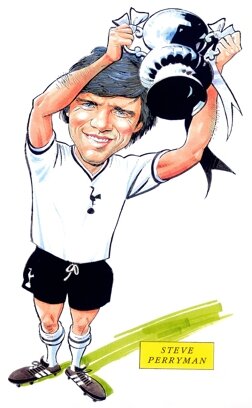
Steve Perryman
There is good news that Steve Perryman has been released from hospital and is making a steady recovery following his heart surgery at the beginning of May.  It's good to know that he is making progress and  everyone would once again want to wish Steve a continued speedy recovery.

Steve holds the record for appearances for the club from his debut in 1969 to his departure in 1986.  He won the League Cup twice and the UEFA Cup in the 1970s and then captained the FA Cup winning team in 1981 and 1982.  He was part of the UEFA Cup winning team in 1984 but missed out in the final due to suspension.  He later returned to White Hart Lane as assistant manager to Ossie Ardiles.

Pat Jennings
On this day, 12th June, 1945 the greatest ever Tottenham Hotspur goalkeeper was born in Newry, Northern Ireland.  Signed from Watford in 1964, Jennings made 472 League appearances for the club and won the FA Cup in 1967, the League Cup in 1971 and 1973 and the 1972 UEFA Cup.

Happy 67th Birthday, Pat and we wish you many more.

Jennings Signed from Watford: here
Pat Jennings to be Honoured by UEFA: here


Google

Tuesday, September 27, 2011

Tottenham's Joy of Winning the Cup 5 (1972)

Tottenham have enjoyed success in Europe and Bill Nicholson is quoted, "It's magnificent to be in Europe, and this club - a club like Tottenham Hotspur - if we're not in Europe, we're nothing." The UEFA Cup campaign of 1971-72 was a long and tiring road but ultimately successful.

Tottenham won the League Cup in 1971 by defeating Aston Villa at Wembley.  They qualified to play in the first UEFA Cup competition which replaced the old Inter Cities Fairs Cup.  This was Spurs' first appearance in a European competition for five years since a rather brief and disappointing foray in the European Cup Winners' Cup.

The UEFA Cup, like all European competitions of the time was knock-out tournament over two legs with the Final also played on a home and away basis.  Tottenham played twelve games, visiting four different countries en-route to the joy of winning the Cup.

1971-72 UEFA Cup Final
Wolverhampton Wanderers 1 Tottenham Hotspur 2 (1st Leg)
Tottenham Hotspur 1 Wolverhampton Wanderers 1 (2nd Leg) 
                                                          [Tottenham Won 3 - 2 on aggregate]

Chivers the Inspiration for Tottenham

Martin Chivers
Martin Chivers showed all his power and goal scoring ability to give Tottenham the advantage in the first game at Molineux.  Captain, Alan Mullery, in what was to be his final match in a Spurs' shirt, scored the goal which ensured that Spurs became the first winners of the UEFA Cup and the first English team to win two European trophies.


Road to the Final:
1st Round (1st Leg) v Keflavik (Iceland) (a) Won 6 - 1 Mullery (2), Coates, Gilzean (3)
The anticipated routine win for Spurs with the main interest surrounding Ralph Coates who scored his first goal for Spurs since signing from Burnley during the summer.  The match was also significant as the only occasion when a young Graeme Souness played for Tottenham.  An exciting prospect in the mould of the great Dave Mackay, he came on as a substitute for Mullery.  Impatient for a place in the senior team Bill Nicholson reluctantly sold him to Middlesbrough in January, 1973.

1st Round (2nd Leg) v Keflavik (h) Won 9 - 0   
                                 Knowles, Coates, Perryman, Chivers (3), Holder, Gilzean (2)  (Agg. Won 15 - 1)
A full strength team played in the second game at White Hart Lane and gave Spurs an their highest ever aggregate success in European football.

2nd Round (1st Leg) v FC Nantes (France) (a) Draw 0 - 0
A much more difficult match saw Spurs relieved to return home with the tie in the balance but with home advantage in the next match making them slight favourites.


2nd Round (2nd Leg) v FC Nantes (h) Won 1 - 0 Peters  (Agg. Won 1 - 0)
In a close encounter Martin Peters scored the all important goal in what was a very tense, nervy evening for everyone at White Hart Lane.

3rd Round (1st Leg) v Rapid Bucharest (Romania) (h) Won 3 - 0 Chivers (2), Peters
An early goal set Spurs up to take a three goal advantage to Romania thanks to the two Martins whose understanding and link up play along with Alan Gilzean was a feature of the season. 

3rd Round (2nd Leg) v Rapid Bucharest (a) Won 2 - 0 Chivers, Pearce  (Agg. Won 5 - 0)
On paper, this result looks quite straightforward but Spurs had to deal with some of the most robust tackling and tactics that they had ever met in European football.  For the players, it was the survival of the fittest, many finishing the game with knocks and bruises, leaving Bill Nicholson so infuriated that he branded Rapid as the dirtiest team he had ever experienced.  Chivers and substitute, Jimmy Pearce scored.  Pearce replaced the injured Gilzean but was only on the pitch for  twelve minutes, just long enough to come on, score the first goal and get sent off.

4th Round (1st leg) v UT Arad (Romania) (a) Won 2 - 0 England, Morgan
After the previous round, the last thing Spurs wanted was a return trip to Romania but this time they recorded an uneventful but comfortable win with goals from Mike England and Roger Morgan who was trying to come back after being out through injury for eighteen months. 


4th Round (2nd Leg) v UT Arad (h) Draw 1 - 1 Gilzean  (Agg. Won 3 - 1)
The draw provided Spurs with a comfortable passage into the semi-finals - Gilzean getting the goal.

Semi-Final (1st Leg) v AC Milan (Italy) (h) Won 2 - 0 Perryman (2)
Alan Mullery and Steve Perryman were the names which made the headlines from this game.  Mullery had been out with injury earlier in the season and when fit had been unable to displace John Pratt.  Wanting to be playing he asked to go out on loan and joined Fulham.  However, an injury to Pratt just before the semi-final saw Nicholson unexpectedly recall his captain and instal him in the team.  

Steve Perryman produced a man of the match performance to give Spurs a slender advantage going into the second leg.  Spurs found themselves a goal down early on and being outplayed by the experienced Italian team.  Perryman showed industry and endeavour to drag Spurs back into the game, scoring from the edge of the box just before half-time and then repeated the exercise late in the second half.

Semi-Final (2nd Leg) v AC Milan (a) Draw 1 - 1 Mullery  (Agg. Won 3 - 2)
Spurs withstood Milan's expected early onslaught and on seven minutes mounted an attack from which Mullery scored.  Mullery was the inspiration as they then defended as if for their lives and although Milan scored with a penalty twenty minutes from time, they held out to reach the Final.

Final (1st Leg) v Wolverhampton Wanderers (a) Won 2 - 1 Chivers (2)
Tottenham's season started with a League game against Wolves and there was some disappointment that it was going to end there against an English team rather than in a glamorous European setting.  It was Martin Chivers and Pat Jennings who inspired Tottenham to grab the first leg initiative.  Jennings produced a series of outstanding saves to foil Wolves while Chivers scored two goals of amazing quality.  The first was a powerful header and although Wolves levelled, he then scored a late winner with a ferocious shot following a powerful run from halfway.

Final (2nd Leg) v Wolverhampton Wanderers (h) Draw 1 - 1 Mullery  (Agg. Won 3 - 2)
Alan Mullery played a captain's part in this game and led by example, putting Spurs ahead after half an hour, injuring himself as he dived to meet Peters' free-kick.  Wolves battled back to equalise before half-time but Spurs held on, exhausted after playing 68 matches during the season.  It was a night of triumph for Mullery - to score and lift the trophy in his last game for Tottenham.  During the summer he was transferred to Fulham.  Bill Nicholson was so disappointed with Tottenham's performance that he first went to commiserate with the Wolves players.
     

1972 UEFA Cup Winners - Tottenham Hotspur
At the end of a long, exhausting season Spurs had won a trophy - they missed out in returning to Wembley in the League Cup when Chelsea scored a very late equaliser, they lost in the 6th Round of the FA Cup to eventual winners Leeds United and finished 6th in the League.  A second European triumph was added to those 'Glory, Glory Nights' at White Hart Lane.


Google

Friday, September 23, 2011

Tottenham - A Winning Mentality

Do Spurs have that desire to win at any cost which the top clubs possess?  Those clubs have players who don't know what it is to be beaten and when they are, they don't like it.  That makes them stand out from all the other clubs around them but do the players at Tottenham have that same desire and winning mentality?

Is Scott Parker a Leader for Spurs?
Tottenham have always been regarded as a soft touch - a team who won't perform on a cold wet night in the north west.  Players will go missing and won't take responsibility when the going gets tough.  Do the current players have the desire to turn such opinions around?

Last year the team managed to gain 22 points from losing positions but they gained only 11 points out of a possible thirty from the bottom five teams in the Premier League which affected their final position dramatically.

The team has won their last two Premier League games but went out of the Carling Cup on penalties at Stoke.  The weakened team contained eight international players but they were unable to score in two hours of football and when it came to penalties their defeat was the sixth consecutive penalty shoot-out loss. When it came to the pressure of the shoot-out, it was an international striker, Roman Pavlyuchenko, who missed a crucial early strike so transferring the pressure to other less experienced players.  Similarly, the defeats in the Carling Cup Final and UEFA Cup match against PSV Eindhoven saw seasoned Premier League players with international experience miss vital kicks at a crucial time in the shoot-out, David Bentley and Jermaine Jenas.

Top teams regularly play under-strength sides in the early rounds of the domestic Cup competitions and have progressed to the latter stages, even going on to lift the Cup.  Tottenham's squad players aided by some talented youngsters weren't able to produce a similar result this week.

The victory at Wolves suggested greater application from the team against opposition who have proved difficult opponents since returning to the Premier League.  The win over Liverpool was pleasing in the energy that the players showed from the start taking the game to their visitors and not giving them a chance to control the game.  The four goal success was their largest win over Liverpool since 1963, so we shouldn't be too critical. However, the one question that has lingered in my mind since last Sunday is - should it have been more?

If things had been the other way round - Spurs at Anfield, reduced to nine men and three down with twenty five minutes remaining, would Liverpool have settled for four?  I suggest that they would have gone for the jugular and it would have been an even greater embarrassment than Liverpool felt last weekend.  Manchester United didn't settle for 5 - 1 or 6 - 2 against Arsenal they went for it and left the visitors totally shell-shocked.  Spurs, however, having gone three up and with Liverpool offering nothing, settled for playing 'keep ball' with pass after pass in midfield, not looking to create anything and Liverpool were content to let them do that as they weren't under any threat.  A team  with a winning mentality would have benn looking to create more chances, score more goals and make their opponents really suffer, as frequently happens to Spurs.  As it was Tottenham's fourth goal didn't come until the last kick of added time with Emmanuel Adebayor putting away Benoit Assou-Ekotto's cross.

Successful teams have players who lead by example and never know when they're beaten.  Steven Gerrard is the perfect example of that special type of player when he is wearing the 'red' of Liverpool.  He has pulled them through many 'lost' causes to success and they have an outstanding penalty-shoot record in vital European and Cup games.  Last season's defeat to Northampton Town at Anfield when Tottenham's Oscar Janssen was in goal for the visitors was an amazing 'blip' on an incredible record.  Manchester United had Roy Keane and Brian Robson who led by example, Livwerpool also had former Spur, Graeme Souness, but it is some time since Spurs had such a player in the team.

Graham Robers - a Leader
The most notable example is Dave Mackay from the 1960s with Graham Roberts and Paul Miller created from the same mould.  In Tottenham's UEFA Cup Final success in 1984, Roberts scored the equalising goal against Anderlecht and then led by example as captain on the night, by scoring the first penalty in the successful shoot-out.  Alan Mullery and Steve Perryman had similar qualities and were prepared to roll up their sleeves and get on with it when the going was difficult.  Who of recent Tottenham experience has had such a presence in the team?  William Gallas is certainly a 'winner' who doesn't take kindly to losing and on a number of occasions last year he showed that spirit when battling on with minor knocks and injuries bandaged or strapped up, rather than be substituted.

Harry Redknapp has often lamented the lack of a player with such character and qualities and the experience of Scott Parker was something that the manager felt would be of benefit to the current team.  A player prepared to fight for the right to play and not afraid to battle when things get tough.  He showed such leadership qualities while battling with West Ham last season.

The match against Wigan won't provide any conclusive answers but a defeat would further strengthen the argument that the Spurs players still lack a winning mentality while success would provide an indication that they might just be moving away from that 'soft' Londoners tag.



Google

Thursday, September 08, 2011

Why Does the Tottenham Academy Produce So Few Successful Players?

The Tottenham Hotspur Academy spends vast sums of money annually in the search for talented youngsters who will develop into successful players at the club.  Why do they have such a low success rate?
New Training facilities at Bulls' Cross, Enfield

The evidence in the previous blog, 'Where Have All the Tottenham Academy Players Gone?' suggests that in the past twenty years only six players who have passed through the Academy/youth system at the club have developed into a regular member of the Premier League team at White Hart Lane.  While hundreds of youngsters can claim to have played for Spurs, a very small percentage have managed to make a career even in football's lower Leagues after leaving the club.  Why have there been so few success stories over the past two decades at Tottenham while other top clubs have produced players through their youth scheme?  Manchester United built the foundation of their Premier League successes on the young players who developed through the exceptional youth team which produced a list of international stars - David Beckham, Paul Scholes, Ryan Giggs, Gary and Phil Neville.  Even smaller clubs who have slipped out of the Premier League in recent years  have seen their youth system produce players of a very high calibre.   Southampton have brought on Gareth Bale, Thoe Walcott and Alex Oxlade-Chamberlain.  Leeds United had to sell a number of their best youngsters to ensure their survival, including Aaron Lennon and Danny Rose while Nottingham Forest's youth system has seen players like Michael Dawson and Jermaine Jenas be sold on to clubs in the Premier League.

What is Wrong at Tottenham?
The young players in the Tottenham Academy are expected to play their football in the 'Tottenham' way - being able to pass and move, being confident on the ball and prepared to play football from the back.  The youth teams are required to play in a fashion similar to the senior team with the coaches aiming to develop their skills to play football as it should be played.

These players are given top class coaching and play for the Academy teams against other Premier League clubs.  They also have the opportunity to participate in tournaments around Europe so that they can compare and test themselves against the very best young players and teams. The recent success at the Eurofoot tournament and in other competitions in the past shows that the Spurs Academy is producing quality players at their level.  Spurs often include under-age players in their squad for these tournaments so as to broaden the experience of the players and the level of competition they are facing. For the club, the winning of such tournaments is not the chief goal, rather it is the experience that the young players gain from the competition although developing a winning mentality is also important.

Tottenham Hotspur have excellent facilities at Spurs Lodge and are developing a new training complex at Bull's Cross, Enfield for the first team and the Academy.

The club employs qualified and experienced coaches to oversee the development of the young players and have a nationwide scouting network.  The scope of the scouting operation is no longer restricted to these shores as the introduction of young players from oversees in to the Academy is becoming an important aspect of their work.

Everything would appear to be in place for Tottenham to produce high quality young players for the first team but why do these highly regarded 'prospects' who do so well at schoolboy and youth football not make those final steps up to the next level?

The answer, perhaps, lies with some of these considerations:
  • Tottenham Hotspur as a club are too impatient for success to wait for the final development of their Academy players.  They require instant success so choose to purchase a player from another club rather than put their trust in one of the youth team. 
This has always been an issue for Spurs.  Even in the successful era of Bill Nicholson, the FA Youth Cup winning team of 1970 produced only one long-term player for the first team - Steve Perryman.  Other members of that team made some appearances for the first before leaving for other clubs, including Graeme Souness, Barry Daines, Phil Holder, Mike Dillon.  Others left without any first team experience but had successful careers - Mike Flanaghan and Ray Clarke.
  • While the Academy players are provided with numerous opportunities to play competitive football up to the age of eighteen, their chances of  games after that become more limited as the club no longer has a team in the Premier League Reserve competition.  Young players now play in 'friendly' matches arranged for the Spurs XI or go out on loan to clubs in the lower Leagues.
The use of a Spurs XI, rather than having a reserve team, with young players going out on loan is a recent innovation so it will be interesting to see if it is any more productive that the previous system.
  • Over the past two decades, Tottenham has been a club which has changed their manager every few years.  Every new manager brings his own ideas and requirements so their has been no element of stability within the club and this would have an effect even at youth level.  Each new manager has been aware that he is required to bring success to the first team and so that has been the focus of his attention to the detriment of players coming through from the Academy and so  restricting their opportunity for development in to the first team squad.  If the manager is under threat he doesn't have time to wait on young players and can't afford to put his confidence in them as they learn their trade in the first team, as mistakes could cost him his job.
It is widely speculated that Harry Redknapp will become the next England manager when Fabio Capello steps down next summer.  If that is the case then Tottenham's recent history of manager changes will continue.  There has also been the move away from the Director of Football role which the club had implemented for a number of years with David  Pleat,  Frank Arnesen and Daniel Comelli who each brought a different perspective to the position. David Pleat concentrated on bringing young players from other English clubs which saw the likes of Matthew Etherington, Michael Dawson, Simon Davies and Gary Doherty come to the club.  Frank Arnesen had wide contacts across Europe concerning youth football while Comelli brought in players from the Continent like Adel Taarabt.
  • During the Premier League years Spurs have been a team which has been struggling to free itself from mid-table mediocrity.  A club which constantly feels it should be doing better but finding it difficult to break out of the constraints it finds itself in.  The senior players, in the many cases, have been under pressure to perform at a higher level than they've been capable of and so have not been in a position to nurture and support a young prospect taking their first tentative steps in the first team.  Ideally, a young player making his debut wants to go into a team that is playing confidently with senior players who are able to support and give them advise during a game.  Unfortunately, Tottenham Hotspur have not had a team like that - they have on occasions been more concerned with trying to avoid relegation or struggling to achieve a place in Europe, constantly playing catch up - nearly there but falling short.  Even with the improvement in recent years, it has never been easy, nothing has been guaranteed and there's been no room for a mistake.  Every match has been vital in the race for a Champions League place and the manager has relied on his experienced players.
The senior team has lacked a dominant leader, an inspirational player who in times of adversity has taken the game by the scruff of the neck and turned it round for Tottenham.  The role that Dave Mackay thrived on and that Steven Gerrard does so well for Liverpool.  Younger players need a player like that to look up to and follow their example. It is a long time since Spurs have had such a player.
  • The Premier League teams have so many players in their squads that rarely is their an opportunity for a young player to get in to the team.  A top team can have seven internationals sitting on the bench as substitutes and some may not even have been included in the full match squad.  Both Spurs and Manchester City struggled last season with surplus players - David Bentley, Alan Hutton, Robbie Keane, Wayne Bridges and Emmanuel Adebayor.  This greatly restricts the playing opportunities for all young players. 
seven named substitutes, three to be used but no young players make it on to the bench.  Spurs have off-loaded some of their surplus players in the last transfer window, players who were taking up those positions but were very unlikely to be in the team on a regular basis.  Some younger players may now be given an opportunity late in a game to experience the pace and intensity of Premier League football as part of their development. Too many experienced players seeing out their contracts, leaves young players frustrated and feeling that they will never be given a chance to show their worth.  It was this sense of frustration that led to Spurs losing one of their brightest prospects in the early 70s.  Graeme Souness faced with Alan Mullery, Martin Peters and Steve Perryman ahead of him couldn't wait to be given a chance and created such a nuisance of himself that Bill Nicholson lost patience and sold him to Middlesbrough and the rest is history - Scottish international, captain of Liverpool's successful team of that period and winner of five League titles, three European Cups and four League Cups.
    • The increasing number of overseas players in all divisions of English football is restricting the opportunity for young players to develop.  Prior to the arrival of Ossie Ardiles and Ricky Villa clubs in England had players from the four home countries and  Ireland.  The introduction of players from overseas developed slowly from that point but now it has taken over and  fewer 'home' players are playing in any of the Leagues. 
    Young players from overseas are now being courted by the major clubs in England and this tendency will only increase in the years ahead.  The problem for these young players is being able to settle in England without feeling home-sick and clubs have lost promising youngsters for this reason with Paul-Jose M'Poku returning to Standard Liege during the summer after two seasons with Spurs and a promising period on loan with Leyton Orient last season.
      • Tottenham tend to look for a particular type of player for their youth Academy.  Players who are highly skilled but many of them are lightly built and their stature and physique may be a hindrance when it comes to that final step up in professional football.
      Good players will show through whatever their build - as the old saying goes, 'If you're good enough, you're big enough.'
      • The expectations placed on the young players are very high and any player who is rated highly through international representation at their age-level and outstanding performances for the Academy teams will come under the spotlight even more which will fuel the supporters expectations even more.  Of the current group of young players at Spurs, Harry Kane who is only 18 years old has received high level recognition among fans because of his great goal scoring record for the youth teams.  This has brought him into consideration for the first team in the Europa League with his debut coming against Hearts.
      Great things were expected of Steve Perryman when he arrived at Spurs in 1967, similarly with Glenn Hoddle and both went on to make it and fulfil their outstanding potential.  Today with the internet, messageboards, twitter and media fans are so much more aware of young players.  Previously, if a young player were doing well in the youth team or reserves, it would only have been those who attended matches and read the programme who would have an inkling of this young players success.  However, fans are now more aware of the young players at the club and how they are progressing.  The arrival of the young players who were signed during the summer may take the spotlight off Harry Kane and allow him to continue his development at an appropriate pace.
        • Young players who are taken on by top clubs are footballer with natural ability are the outstanding players in schools' football.  Playing football has always been easy to them and they were confident in their ability, winning trophies with their school and on a personal level.  For some the step up to the Academy and professional football will come a s a shock to them.  For some they will no longer be the best player around and it will become a struggle and they may not be prepared for the application that is required to meet that situation.  These players may discover players who have had to work much harder in their younger days overtaking them through their hard work and endeavour.  Also players who mature early will be taller and stronger than those they are playing against at school level but when others catch up, the difference in level of ability may even itself out. 
        As the young players are growing up they have the support of their parents and family who take them to training and attend matches each week.  However, as they get older they have to make decisions for themselves, especially if they are away from home and have a greater freedom.  Will they continue to show the discipline which earned them the opportunity at the football academy?  If they don't then their progress may be compromised. 
          • Everything is laid on to help the Academy players in their development and some come to take this for granted and so lose the desire to push on and make the further sacrifices and effort that are needed to reach the highest level.
            Even the best players can find things too comfortable and need to guard against complacency.

            Hopefully, the current group of players coming through the Academy and the young professionals who are highly regarded will be able to overcome the many obstacles which stand in their way to becoming a top class footballer with Spurs.  With the required application and endeavour and the good fortune that is essential some of them must have an opportunity to have lengthy careers in football.  To the outsider, it looks and seems glamorous but for those young men who are working their way through the system, there will be uncertainty and many disappointments but in the end if they achieve their life long ambition, it will all have been worth it.


            Google

            Friday, January 18, 2008

            Sunderland Aim to Spoil Spurs' Party Again!!

            Saturday’s game at White Hart Lane will be the 100th competitive meeting between Spurs and Sunderland with Tottenham holding a slight advantage in the overall record with 38 wins ahead of Sunderland’s thirty five.

            Through that record, Sunderland have a history of spoiling Spurs’ hopes and ambitions.

            Back in 1938, no I wasn’t there, Sunderland travelled to London for an FA Cup 6th Round tie. Sunderland were the 1st Division side and the FA Cup holders while Spurs had dropped down into the 2nd Division three years earlier and White Hart Lane recorded the highest ever attendance – 75,038 were packed into the ground as the players took to the pitch. Such a scenario, a record crowd, deserved a home win but Sunderland had other ideas, however their victory was not without controversy.

            Today’s television commentators would have been in their element trying to assess if the Spurs’ forward had handled the ball before or after it crossed the line. It was into the second half of the exciting game when a cross shot from Colin Lyman was handled by Spurs’ Jack Gibbons as it crossed the line. Was it a goal? The referee awarded a goal but after consulting the linesman, he ruled against Spurs. Sunderland having escaped that scare won the game late on when one of their most famous players, Raich Carter, scored the only goal.

            In September,1969 after a poor start to the season, Spurs manager, Bill Nicholson, gave a debut to a young home grown player for the visit of Sunderland. His name was Steve Perryman. Unfortunately, Sunderland rather spoiled his first game by again winning 1-0 through an own goal from Spurs’ Welsh international, Mike England. At least the early set-back to his career didn’t upset Perryman who went on to become Spurs’ captain and to be a vital member of the successful Spurs’ teams in the early 1970s and 1980s as well as make a record 854 appearances for Spurs in all competitions.

            In 1961, 2nd Division, Sunderland almost achieved something that the top clubs of the day failed to do. They made Spurs fight all the way in the FA Cup 6th Round tie at Roker Park. Spurs had taken an early first half lead through Cliff Jones but after half-time Sunderland came roaring back, fully supported by their fans who created an incredibly atmosphere in the ground. Sunderland equalised through Willie McPheat and by the end Spurs were greatly relieved to escape Roker Park with a draw but they managed to win the replay in mid-week to continue on their way to the ‘Double’.

            Spoiling Spurs’ ambitions – Sunderland don’t have to go back any further than last August, the opening day of the season and a deserved win with a last minute goal from substitute, Michael Chopra. Spurs went in to that game with such high hopes for the season but they fell flat in the face of a determined performance from Sunderland.

            Sunderland will be hoping to do the same on Saturday and deflate Spurs’ tentative recovery under Juande Ramos. Roy Keane will demand total commitment and hope to add further misery to Spurs’ season.

            Having remembered some of Sunderland’s finer moments against Spurs, I will just mention a Spurs’ legend. Jimmy Greaves loved playing against Sunderland – 10 goals in total, including four in a game in 1968. Perhaps, Berbatov could take over that role, if he’s in the mood.

            Enjoy the game!!!!


            Google


            Tuesday, August 21, 2007

            Spurs in History - 21st August

            21st August, 1982

            Liverpool 1 Spurs 0 F.A.Charity Shield at Wembley.

            Newly signed from Bristol Rovers, Gary Mabbutt made his debut in Spurs midfield. Spurs were without influential players like Steve Perryman and Graham Roberts with Paul Price also unavailable through injury.

            The game was a robust affair and many competitive tackles came in from both sides – this may have been something left over from the previous season’s Milk Cup Final when Liverpool set about unsettling Spurs early on in the game which left Tony Galvin to play most of the game bearing the pains of some hefty tackles which greatly reduced his effectiveness.

            Google


            Monday, July 02, 2007

            Spurs in History - 6th July

            6th July, 1993

            On this day Ossie Ardiles who had been appointed manager in the aftermath of the departure of Terry Venables following his acrimonious fall-out with Alan Sugar, announced his management and coaching staff.

            Steve Perryman was to be the Assistant Manager and Pat Jennings was returning to the club as the specialist goalkeeping coach.

            This meant that the Venables’ coaching duo of Clemence and Livermore was broken up. Ray Clemence left the club while Doug Livermore remained to oversee the scouting.


            Google


            Tuesday, June 19, 2007

            Spurs in History - 19th June

            19th June, 1993


            Ossie Ardiles appointed Manager of Tottenham Hotspur

            With the departure of Terry Venables, Alan Sugar required a manager who would appease the fans who were still very angry and in shock following the revelations and press attention of the previous six weeks.

            Having missed out on his original choice, Glenn Hoddle, he turned to another Spurs' favourite, Ossie Ardiles who was managing West Bromwich Albion. Sugar realised that he needed to appoint someone who would be popular with the fans which he hoped would buy him time to restore calm and order to the club.

            Keith Burkinshaw had been Ardiles Assistant at WBA but he did not follow him to White Hart Lane. It was former captain and record appearances holder, Steve Perryman who became his second in command.


            Google


            Monday, June 11, 2007

            Spurs in History - 11th June

            11th June, 1983

            Manchester United 0 Spurs 2 (Royal Swazi Sun Challenge)

            Spurs played two games against United in Swaziland, losing the first match by 1-2 a week earlier.

            This game was won with goals from Steve Perryman and Gary Mabbutt. A full strength team took part in the tournament which Spurs won in a penalty shoot-out after this game.

            Spurs won 3-2 on penalties with Alan Brazil, Paul Price and Perryman scoring.


            Google


            Thursday, April 26, 2007

            Spurs in History - 26th April

            26th April, 1978

            Spurs 1 Hull City 0 (2ndDivision)

            The previous weekend, Spurs had increased the pressure on themselves in their promotion bid by losing at home to Sunderland. This time there could be no mistakes against Hull who were bottom of the Division.

            They say that fortune favours the brave and this was the case as the only goal was scored by Captain, Steve Perryman. The game had reached the last ten minutes with the Hull goalkeeper standing firm to deny Spurs a goal. The goalkeeper caught a cross from a corner but when a Spurs forward challenged him he dropped the ball allowing Perryman to score.

            The relief around White Hart Lane was unbelievable.


            Google


            Thursday, April 19, 2007

            Spurs in History - 19th April

            19th April, 1972
            A C Milan 1 Spurs 1 UEFA Cup Semi-Final (2nd Leg)

            In the early stages of the 1st Leg at White Hart Lane AC Milan had given Spurs a footballing lesson in retaining possession and generally having them chasing shadows, taking the lead after 25 minutes.

            However, as the game progressed, Spurs came more into it, particularly due to the leadership of Alan Mullery and the tenacity and determination of Steve Perryman who equalised after 33 minutes and scored the winner in the second half after an Italian player had been sent off. In a recent interview Perryman described this game as the match of his life - everything that he did in that game worked perfectly.
            For the return, Milan were confident that the away goal would be vital to them. However, Spurs produced a most accomplished and assured performance to progress to the Final. Captain, Alan Mullery was the inspiration, giving Spurs an early lead (7th minute) to score the important away goal. With twenty minutes remaining Milan were awarded a penalty to equalise but Spurs held out to reach their second European Final.

            Mullery had missed a portion of the season through injury but on regaining fitness was unable to get back into the team. He went to Fulham on loan and it was only due to an injury to John Pratt over the Easter games that Mullery was recalled to play in the 1st leg of the semi-final. He led from the front and was an inspiration to everyone around him.

            Google


            Monday, April 16, 2007

            Spurs’ Players ‘Bottled it’ in their ‘Big’ Games

            Time for Spurs to Show their Worth against Arsenal

            So near and yet so far could be the epitaph for Spurs’ season. It, like last season, will be remembered, if it is, for the ‘nearly’ achievements. Carling Cup semi-final defeat after extra time in the second leg, FA Cup quarter-final defeat after a replay and a single goal aggregate defeat in the UEFA Cup Quarter-final tie. Compared with Spurs’ record over the last number of seasons that is some progress but when it came to those ‘big’ games the players lost their nerve.

            In both of the domestic Cups they held a two goal lead but against Arsenal the departure of Dimitar Berbatov early in the game through injury saw Spurs’ former confidence drain away and the Arsenal youngsters were able to impose themselves on the game and ultimately on the tie. ‘Disappointed,’ said the players, ‘we don’t want that to happen again, we’ve learned from that.’

            And so for the FA Cup 6th Round game against Chelsea, the players were up for that game and took Chelsea by surprise. A lethargic Chelsea were trailing 1-3 at half-time and even in the second half as Jose Mourinho threw on striker after striker in an attempt to rescue the situation, Spurs had the chances to put the result beyond doubt. The substitution of Berbatov again proved costly as Spurs lost their threat in attack and Chelsea eventually scored the goal which gave them the hope of a comeback. Sure enough, having scored one the equaliser soon followed. Chelsea had rescued the situation and going to White Hart Lane wasn’t a problem to them. So it proved in the replay, Chelsea contained and two moments of magic secured the game. The Spurs’ players once again had failed to produce their best when it really mattered.

            The UEFA Cup quarter-final draw produced another difficult game for Spurs. Sevilla, the Cup holders and the team challenging Barcelona for the Spanish Liga title would be the most difficult opponents that Tottenham would have to face in their European journey this season.

            However, it would be different this time.

            Jermaine Jenas commenting before the first leg game in Sevilla,

            ‘You get nothing for reaching quarter-finals or semi-finals. You go home, you are out and you have to watch others play in the final and lift the cup. It’s not a nice feeling and it’s not something we want to continue. If you look at the teams we lost to [in the cups], it has been Arsenal and Chelsea, two of the top three or four sides in England. It was devastating to lose those games. But now, it’s up to us to make that step and beat those sides so we are able to break through into finals and so on. We definitely have the talent.’

            That was good to hear from a Tottenham perspective, the players realised that they had to raise their game for these important matches.

            In Sevilla, Spurs were unfortunate that a refereeing decision preventing them from building on the excellent start given to them by Robbie Keane’s early goal. The penalty award set Spurs back and rejuvenated the home team and for the rest of the first half Spurs appeared to be in shock. The half-time interval allowed them to regain their composure and re-organise so that they finished the game well although unable to score a second goal.

            A single goal deficit going into the second leg at home was acceptable. Tottenham knew exactly what was needed. However, within seven minutes that was shattered and Spurs’ European dream was over. The two quick goals midway through the second half didn’t alter the course of the game as Sevilla with Tottenham old boy, Fredi Kanoute, qualified comfortably.

            In spite of Jenas’ words, once again the Spurs’ players failed to rise to the occasion and produce a performance worthy of the occasion. The Sevilla players were much quicker to the ball and prepared to battle together for the result. They started quicker and Spurs were caught cold and never recovered from it.

            This has been the case for Tottenham over many seasons. Their record against the top four sides is abysmal – the only light in this darkness was the unexpected home win over Chelsea in the Premiership earlier this year. Every year Manchester United, Chelsea, Arsenal and Liverpool brush them aside as of little consequence. Other teams achieve unexpected wins over the top clubs. Bolton have been a regular thorn in the flesh for all the top sides for a number of seasons, Portsmouth have done it as well and West Ham United, this season fighting against relegation have achieved their second successive away win against Arsenal having already beaten them and Manchester United at Upton Park earlier in the season. So of their meagre total of twenty nine points, West Ham have earned nine of them with wins against two of the top four sides while Spurs have taken three points. The Spurs players have failed to raise their game for season after season – regardless of who is playing – there is an obvious lack of believe at the club and an acceptance of being second best.

            Martin Jol talks of the players showing a ‘winning mentality’ but it is lacking when faced with the top sides. A lack of leadership and drive on the field is evident with Spurs needing the fighting qualities displayed over many years by former captains, Steve Perryman, Graham Roberts, Alan Mullery and Dave Mackay.

            How would the Spurs players respond to the management style displayed by Sir Alex Ferguson or Roy Keane? Is life too easy at White Hart Lane? If Spurs are to get into the elite of the Premiership a few feathers may have to be ruffled at the club. The summer transfer market shopping list should include that aggressive, combative type of player who ill inspire those around him to greater effort and won’t accept excuses for missed opportunities. Such qualities don’t exist within the players currently at the club so someone is required who will set the example, set the standards and discipline that are necessary to make this forward step.

            As Jamie Carragher said when questioned about Liverpool’s Cup defeats to Arsenal earlier in the season, ‘We need better players.’ That certainly is the case where Spurs are concerned with players who can take the pressure of the ‘big’ games and produce their best performances when they’re most needed and when faced with the highest level of opposition.

            Spurs’ next game is against Arsenal at White Hart Lane. The supporters will be ready for the game but will the players? They know what a North London derby means to the supporters but will they produce a performance on the day or will it again be a case of almost but not quite good enough?


            Google


            Friday, April 13, 2007

            Spurs in History - 13th April

            13th April, 1970


            Spurs 2 Manchester United 1


            The penultimate game of the season, although the final game wasn’t until early May. Following the difficult period in mid-season Spurs had reshaped the team, the senior players had re-established themselves, Peters was settling into the team and Perryman was gaining experience and influence in the team. Also and importantly, Gilzean and Chivers were developing a goal scoring partnership that was to blossom in the next few seasons. It was this combination that was to ensure victory over United but despite the stronger finish to the season, Spurs could only finish in 11th position.

            Google


            Tuesday, March 06, 2007

            Spurs in History - 6th March

            Steve Perryman and Alan Gilzean with the UEFA Cup in 1972

            6th March, 1985

            Spurs 0 Real Madrid 1 UEFA Cup Quarter-Final (1st Leg).


            In all European competitions, Spurs had maintained an unbeaten home record since their debut in 1961. Some of the performances had overturned deficits in exhilarating performances but in this game Spurs lost their unbeaten record in bizarre circumstances.


            The only goal came in a Real breakaway, Ray Clemence palmed out a cross which struck Steve Perryman on the knee and rebounded into the goal.


            Spurs battled gamely in the return game but without reward and the scoreless draw was insufficient. Perryman’s European career ended with a dismissal for a professional foul.
            Google


            Friday, March 02, 2007

            Spurs in History - 2nd March


            2nd March, 1986


            Spurs 1 Liverpool 2 (1st Division)

            This 1st Division game marked the end of an era for Spurs. The team had been having a difficult season and this defeat meant that they had only won once in eight League games, a 2-1 victory at Sheffield Wednesday in their previous match. Chris Waddle scored for Spurs after two minutes but Liverpool won with a last minute goal, denying Spurs a deserved point. This was to be Steve Perryman’s last League appearance.

            Following a Cup defeat to Everton two days later, he was dropped and joined Oxford United. Perryman amassed a record 655 appearances and served Spurs loyally from his debut in 1969. As Captain he led the team to the Cup victories of the 1980s and was an inspirational and committed leader and a model professional.

            Perryman later returned to the club as Assistant Manager under Ossie Ardiles but when Ardiles was sacked, Perryman took charge for one game until a new appointment was made.  The team lost at Blackburn Rovers by two goals to nil in November, 1995.  By the time of the next game, Gerry Francis had been appointed and Perryman had left the club.  He later teamed up with Ardiles to manage in Japan.

            Thank you Steve Perryman.

            For more about Steve Perryman - go to his Official Web-site: http://www.steveperryman.com/

            Google


            Monday, March 06, 2006

            6th March - Spurs in History


            1982 FA Cup 6th Round Chelsea 2 Spurs 3

            Defending the trophy, Spurs had already beaten Arsenal, Leeds United and Aston Villa at White Hart Lane, each game won 1-0.  Goals from Steve Archibald, Micky Hazard and Glenn Hoddle took Spurs into a semi-final against Leicester at Villa Park.

            Spurs were on their way to Wembley again!

            On this day in 1985, Spurs lost their first home game in any European competition, 0 - 1 to Real Madrid in UEFA Cup. The only goal of the game was an own goal scored by Steve Perryman. Ray Clemence palmed out a cross which hit Perryman on the knee and cannoned into the net.

            A scoreless draw in the 2nd leg saw Spurs go out of the competition in the 4th Round.

            1974
            FC Cologne 1 Spurs 2 UEFA Cup 4th Round (1st Leg)

            A great away win, thanks to goals from youngster, Chris McGrath who was having a great debut season, and captain Martin Peters.  This result put Spurs in a strong position ahead of the 2nd Leg at White Hart Lane.  Spurs took an early lead through McGrath and then defended stoutly. It was early in the second half that Cologne got a deserved equaliser but Spurs continued to defend resolutely and with fifteen minutes left scored on the break through Peters.  This was only Cologne's second defeat at home in European competitions.

            Google


            Thursday, March 02, 2006

            2nd March - Spurs in History

            Steve Perryman & FA Cup
            This day marked the final appearance of captain Steve Perryman for Tottenham Hotspur, thw club he had joined as a boy and served for nineteen years.  He made his 654th League appearance in Spurs colours as the team lost 1-2 at home to Liverpool.  Chris Waddle scored Spurs' goal.

            In total he made 1014 full appearances for Spurs and 8 as substitute.  He was a loyal servant to the club turning professional in 1969 and playing regularly for 17 years. He was a member of Nicholson's successful team in 1970s and captained the team to FA Cup success under Keith Burkinshaw in 1980s. He missed the EUFA Cup win in 1984 because of suspension, but received a medal as Ossie Ardiles insisted he have his.

            A true and worthy Spurs 'Legend.'

            He was transferred to Oxford for £50,000, later returning as Assistant Manager under Ossie Ardiles. This was short lived but he had a successful period managing in Japan.