Showing posts with label Watford. Show all posts

Saturday, January 28, 2012

Watford 0 Tottenham 1 FA Cup 4th Round

With a single goal from Rafael Van der Vaart, Tottenham became the first club to reach the 5th Round of the 2012 FA Cup and that's about the best that can be said for the match and Spurs' performance at Vicarage Road.
Pre-Order Tottenham The Glory-Glory Game: Here (Use Code: LH1)

FA Cup 4th Round
Watford 0 Tottenham Hotspur 1
Scorer: Van der Vaart

Team: Cudicini; Walker, Dawson, Kaboul, Rose; Van der Vaart, Livermore, Parker, Modric (Lennon); Defoe (Pienaar), Adebayor (Pavlyuchenko) Subs (unused): Friedel, Bassong, Assou-Ekotto, Kranjcar

Spurs First to Reach FA Cup 5th Round (just!!)
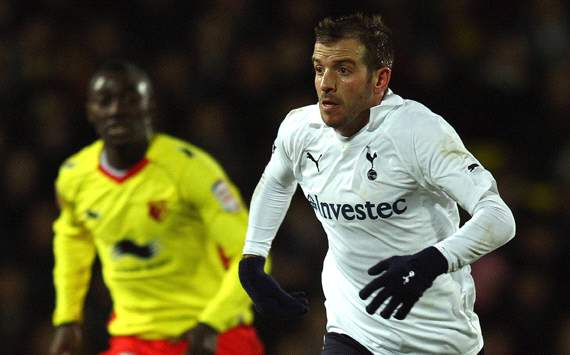
Goalscorer: Rafael Van der Vaart
Tottenham became the first team to reach the FA Cup 5th Round as the match at Vicarage Road ended just ahead of the one at Goodison Park but in another sense they just managed to beat Championship side, Watford, thanks to a goal from Rafael Van der Vaart a few minutes before half-time.

The Spurs team contained six players who started last weekend's game against Manchester City showing that Harry Redknapp realises the importance of winning some silverware this season.  Carlo Cudicini, Michael Dawson, Danny Rose, Jake Livermore and Emmanuel Adebayor came into a team which contained eight full internationals.  With Spurs lacking pace and width it was much easier for the Championship side to contain them and Watford set out with purpose taking the game to their Premier League opponents.

Early enterprise from Watford saw Cudicini parry a shot which a defender cleared and then a dangerous cross to the near post was knocked wide with defenders nowhere and Cudicini relieved.  A long range effort passed wide for the home side with Tottenham offering little threat to the home defenders.  It wasn't until almost the half-hour mark that Spurs managed their first attempt on goal - a weak shot from Jermain Defoe.

While Watford were hard working, industrious and much quicker to every ball, Spurs' display was akin to their home performance against PAOK Salonika when defeat ultimately led to their elimination from the Europa League.  Their passing often fell short and was inaccurate, they were slow on the ball and were often caught in possession and they resorted to playing hopeful long balls forward which caused no problem to the Watford defence.

With such a lacklustre performance Spurs were fortunate to go ahead three minutes before half-time.  Watford had just created some confusion in the Tottenham penalty area which Spurs managed to scramble clear to Kyle Walker who broke at pace and passed the ball on to Van der Vaart having crossed the halfway line.  Van der Vaart for the first occasion found time and space in the Watford half and proceeded towards the goal with options of a pass both left and right but from thirty yards shot and as the ball bounced in front of Scott Loach, the goalkeeper's mistake ensured Spurs were ahead. 

Aaron Lennon replaced a very out of sorts, Luka Modric, at half time but Watford continued to press and could have levelled early in the half following some shambolic defending by Spurs.  It all started with a poor goalkick out by Cudicini putting the defence under pressure and as Dawson gave the ball away, it was only a finger tip save by the veteran goalkeeper that retrieved the situation as he touched Sean Murray's shot onto the post and the rebound was blazed over.

Spurs best attack of the evening saw a Rose cross met by Kyle Walker and pushed over by the goalkeeper. 

Watford always looked more likely to score as Spurs continued to concede possession with sloppy defending and only occasionally offered anything of an attacking threat although a Van der Vaart shot hit the bar after he combined well with Lennon and Defoe with just over an hour played.

Spurs failed to learn from earlier mistakes and nearly conceded after giving the ball away outside their own area.  Such were Spurs attacking limitations that it was only with about fifteen minutes remaining that I realised that Emmanuel Adebayor was still on the pitch as he chased a ball out after defending a corner, so anonymous had he been in the second half.

Cudicini saved for a corner from a high dropping cross and then Watford struck the outside of the post for a second time from the corner.  Watford who had lost their last three League games were giving Spurs a fright and brought on former Tottenham player Mark Yeates.


Cudicini again saved and then again as he blocked with his feet from a free-kick and a defender cleared.  With ten minutes remaining a fierce drive was blocked by Dawson who knew nothing about it as Watford continued to seek an equaliser and an opportunity of the replay their performance deserved. 

Spurs held out and maintained their unbeaten Cup record against Watford but it was the home side who deservedly received all the credit as their attempts on goal was over three times greater that Tottenham's and their performance was far superior than suggested by their position in the Championship.

Spurs progress with their first 1 - 0 FA Cup 4th Round success since defeating Leeds United in 1982. and they went on to win the Cup that year.  An omen, perhaps, but performances would need to show considerable improvement for any such dream to become reality.


Google

Friday, January 27, 2012

They Played for Spurs and Watford

Two Spurs 'Legends' are linked with Watford.  Spurs signed Pat Jennings from Watford in 1964 when former Tottenham captain, Ronnie Burgess was manager of the club.  At least twenty eight players have connections with both clubs at some time in their careers but only two have joined Spurs from Watford.  The other transfers have been in the opposite direction with a number of players moving on loan including Andros Townsend who spent time at Vicarage Road last season.
Pre-order Tottenham The Glory-Glory Game: Here (Use Code LH1)
Pat Jennings
Pat Jennings was a young, inexperienced goalkeeper when Bill Nicholson signed him from Watford in June, 1964 for £27,000.  The Northern Ireland international had just won his first two caps and had played only 48 League games for Watford in his year with the club when Nicholson decided to buy him.  He had cost Watford £6,000 when he joined from Newry Town in 1963.

Nicholson was looking to rebuild his team following the demise of the 'Double' team and as he had done the previous year with Watford, Jennings stepped straight into the Spurs team in place of Bill Brown.  His debut was in a 2 - 0 win over Sheffield United on the opening day of season 1964-65.

Initially, Nicholson must have had doubts about Jennings as he took time to settle and during his first two seasons he shared goalkeeping duties with Brown.  By the start of 1966-67 Jennings had made the position his own and after  a few months Brown was allowed to join Northampton Town.  For the next eleven seasons Jennings was first choice goalkeeper at White Hart Lane.  He helped the club to win the FA Cup in 1967, the League Cup in 1971 and 1973 and the UEFA Cup of 1974.  His total of almost 600 League and Cup appearances is littered with numerous match winning performances and a goal having scored in the 1967 Charity Shield game against Manchester United at Old Trafford.

He will always be remembered for the size of his hands which enabled him to come out to catch a cross using only one hand.  His two penalty saves at Anfield as Spurs earned a 1 - 1 draw in 1973 are part of Spurs legend and after a UEFA Cup game in Switzerland Spurs returned with a resounding 5 - 1 victory over Grasshopper Zurich but it was Jennings who received all the plaudits for his performance that evening.

It was only in his last season that Jennings was troubled by injury and as Spurs were relegated manager Keith Burkinshaw made the unbelievable decision to release Jennings in favour of his young understudy, Barry Daines.  Jennings moved to Arsenal and gave them years of outstanding service before returning to Spurs to keep fit for the 1986 World Cup Finals.  He retired on his forty first birthday as Northern Ireland were eliminated from the competition by Brazil.

On retiring he took on the role of goalkeeping coach and is still involved with the club in their corporate facilities.  Pat Jennings was recently honoured by UEFA for winning over 100 international caps for Northern Ireland.

The manager of Watford at the time of Jennings' transfer to Spurs was Ronnie Burgess who had joined in 1936 and played over 450 League and Cup games as well as being captain of the 'Push and Run' side which won the 2nd Division and 1st Division titles in consecutive seasons from 1949 to 1951.  He joined Swansea in 1954 and moved to Watford as manager in 1959.


Tommy Harmer, was known as 'The Charmer' and as a player he spanned the years between the 'Push and Run' team of the 1950s and 'The Double' side of the 1960s but missed out on both.  He joined Spurs as an amateur in 1948 and made his debut in September, 1951 against Bolton.  He played 222 League and Cup games before signing for Watford in October, 1960 having lost his place in the first team to John White.  He was loved by supporters with supreme tricks and skills on the ball.  Lightly built in the rugged midfield battle of those days he was frequently the inspiration for Spurs best performances having taken over from Eddie Baily as the creative influence in the team.  He was at his best in Bill Nicholson's first game as manager, when the new manager restored him to the team.  He was the creator behind the 10 - 4 win over Everton and even managed a goal for himself.  At first, Nicholson tried to play both Harmer and White in his team but eventually opted for the Scot.

In the book about the late John White, 'The Ghost of White Hart Lane', Harmer is described as, 'though he was small, he was a giant' and Julian Holland wrote, 'Harmer was a truly great player.  His tragedy was that his gifts were never fully suited to the type of play current at Tottenham.  Under Rowe he was too static.  Under Anderson he was denied colleagues quick and responsive enough to turn his genius into Champion-ship winning football.  Under Nicholson he lacked the mobility that the new manager looked for. Nor could he supply rapid improvisational touches that Nicholson knew were necessary to overcome planned, coherent defences in 1961.'

Harmer spent two years with Watford before moving to Chelsea as a player/coach and helped them win promotion.

Dennis Bond was a young midfield player who made his name with Watford making over 100 appearances before signing for Spurs in March, 1967 for £20,000.  He had made his debut for the Vicarage Road club at the age of seventeen when Burgess was manger.  He failed to make an impact with Spurs and only made 26 League and Cup appearances in three seasons, scoring once.  He then joined Charlton for £25,000 where he became a regular for three seasons and returned to Watford and made another 200 appearances for the club.

Roy Low has a place in Tottenham record books as the first player to appear for the club as a substitute.  It was on 11th September, 1965 when he replaced the injured Derek Possee against Arsenal at White Hart Lane.  Low was a wing half but he only made eight appearances and scored one goal in his three years at the club.  He joined Watford in February, 1967.

Many well known Spurs players have played for Watford after leaving Spurs.  Gerry Armstrong, while not making any great impression in his five years at Spurs, signed for Watford in November, 1980 and went on to greater things in Spain and with Northern Ireland.

Mark Falco enjoyed greater success at Tottenham having come through the youth system and was a member of the UEFA Cup winning team of 1984.  He joined Watford in October, 1986 and later played for Glasgow Rangers, Queen's Park Rangers and Millwall.  Falco scored 90 League and Cup goals for Spurs and was one of the successful penalty takers in the UEFA Cup Final shoot-out.

From the same era, Paul Miller had developed as an apprentice with Spurs and spent over twelve years at the club before moving to Charlton Athletic in February, 1987.  He played over 200 League games and was a regular in the successful Keith Burkinshaw teams of the early 1980s contributing the away goal against Anderlecht in the UEFA Cup Final.

Steve Hodge who had a short time with Spurs in the mid-80s, having joined from Aston Villa in December, 1986, returned to his first club, Nottingham Forest, in the summer of 1988.  He later played for Watford towards the end of his career.

Tim Sherwood started his career with Watford and after playing for Norwich City and Blackburn, captaining them to the Premiership title, he joined Spurs in February, 1999.  He spent four years with the club, making 93 League appearances, before moving to Portsmouth.  He is currently in charge of Spurs Development squad.

The first player to play for both Spurs and Watford was Bill Lane.  He was a centre forward who spent less than three years with the club from 1924 but only made 29 appearances before joining Leicester City.  He later played for Watford from 1932 to 1936.

Another player from the 1920s who played for both teams was Jack Elkes.  He joined Spurs from Southampton in 1922 and was a forward who could also play at centre half.  He made over 200 League and Cup appearances for the club and moved to Middlesbrough in 1929.  He joined Watford in 1933 spending one season with the club.

John Moran was a full back who had one season with Tottenham, playing twelve matches and then became the first player to be transferred directly between the two clubs by joining Watford in 1932 where he spent four years.

A number of players from the 1950s turned out for both clubs - Bobby Cook, Dennis Uphill, Chris Adams, Johnny Gavin, Alfie Stokes and John Ryden.  Ryden, a centre half, had captained Spurs for a season in the mid-50s but the arrival of Maurice Norman and Dave Mackay reduced his opportunity for first team appearances.  Stokes scored 40 goals in 65 League appearances but was allowed to join Fulham in 1959 as Bill Nicholson put together his new team.

The 1990s also throws up numerous players who spent time at White Hart Lane and Vicarage Road - Mark Robson and Danny Hill, Darren Caskey, all on loan, Ronnie Rosenthal, Espen Baardsen, Allan Nielsen, Ramon Vega and Stephen Kelly and Andros Townsend (both on loan).

Mark Yeates, a former Tottenham player who came through the youth system, is currently in the Watford team.  He made his debut for Spurs on the closing day of the season in May, 2004 setting up a goal for Robbie Keane.  He made three League appearances and after a series of loan periods he joined Colchester United in 2007.  After two seasons he joined Middlesbrough and then moved to Sheffield United.  He joined Watford last summer and has scored three League goals this season from midfield.

Speaking ahead of the Cup tie, Yeates commented on his time at Spurs,  
" Tottenham was a big part of my life ...... so I've got a lot of fond memories.  I've still got a lot of pals there.  Martin Jol gave me a few run-outs, but Spurs are such a big club and at the time in every transfer window they were bringing in three or four new players.  It was hard for the likes of myself, Dean Marney and Johnnie Jackson, we were on the fringes.  Eventually we had to move on but there are no hard feelings."


Google

Thursday, January 26, 2012

Tottenham's Cup Record against Watford

Tottenham's visit to Vicarage Road to play Watford in the FA Cup 4th Round tie is the first occasion that Watford have had home advantage over Spurs in the FA Cup.  The clubs have met previously on three occasions at White Hart Lane and at a neutral venue for a semi-final clash.  Spurs have played at Watford in the League Cup in three matches.  A further FA Cup tie was played at Spurs' old Northumberland Park ground when Watford were known as West Herts.

Carling Cup 5th Round
Spurs last game at Watford was in the Carling Cup in December, 2008 at the 5th Round stage.  They progressed to a semi-final tie against Burnley with a 2 - 1 success through goals from Roman Pavlyuchenko and Darren Bent.

Spurs found themselves a goal behind within fifteen minutes as Watford mounted sustained early pressure.  They drew level on the stroke of half-time with a Pavlyuchenko penalty following a foul on Jermaine Jenas.  Spurs scored the winner with fifteen minutes remaining when substitute Bent latched on to a ball from Pavlyuchenko to score with  a low shot.

FA Cup 3rd Round
The last meeting between the two clubs in the FA Cup was in January, 1999 when Spurs won 5 - 2 at White Hart Lane.  Watford who were in the 1st Division at the time took the lead in the opening minute.  Steffan Iversen equalised on ten minutes as Spurs scored three times in seven minutes.  Three minutes later Darren Anderton scored with a penalty for handball following a free-kick awarded for a foul on David Ginola and then Iversen added his second on seventeen minutes.  Watford showed spirit and pulled a goal back after half and hour but Allan Neilsen restored Spurs two goal advantage three minutes before the interval.

It was not until four minutes from time that Ruel Fox completed the scoring with Spurs' fifth.  Two former Spurs players were included among the Watford substitutes that day, goalkeeper Chris Day and Ronnie Rosenthal.  Rosenthal came on at half-time, receiving a warm welcome from the Tottenham faithful.

League Cup (Coca Cola Cup) 2nd Round
This tie was played over two legs with the first game at Watford in September, 1994.  It marked Jurgen Klinsmann's debut in Cup football in England and he didn't disappoint scoring a first half hat-trick on the ground where he had made his first Spurs appearance in a pre-season friendly the previous August.

Watford took the lead in the opening seconds but Darren Anderton levelled with a shot from the edge of the penalty area.  Then Jurgen Klinsmann completed his hat-trick before half-time to give Ossie Ardiles' attacking team the advantage.  After half-time Watford pulled a goal back before Teddy Sheringham restored their three goal lead.  Ian Walker then conceded a penalty but saved it before Ilie Dumitrescu scored Spurs sixth, only for Watford to pull another goal back through a Gary Mabbutt own goal.

The second leg at White Hart Lane a fortnight later in October, 1994 was just as exhilerating as Watford came out victorious by 3 - 2.  Spurs, however, progressed to the next round with an aggregate win of 8 - 5.  Watford went ahead after fifteen minutes but Nicky Barmby who missed the first match equalised after half an hour.  Watford regained the lead early in the second half but Klinsmann again drew Spurs level only for the visitors to score the winner fifteen minutes from time.  This was Spurs fourth consecutive home defeat and Ardiles was under increasing pressure.

FA Cup Semi-Final
Spurs were progressing serenely towards the Wembley Final when they met Watford at the FA Cup semi-final stage at Villa Park in April, 1987.  The match proved remarkably easy for Spurs who were facing a Watford side who had to find emergency goalkeeping cover due to injury.  The 4-1 victory did not flatter Spurs as David Pleat’s side continued their good form and won through goals from Steve Hodge (2), Clive Allen and Paul Allen. Coventry City were their unexpected opponents in the Final and unfortunately that match didn't go as expected.

League Cup 2nd Round
In September, 1975 Spurs visited Vicarage Road for a Cup match for the first time.  They won against the 4th Division side through the only goal scored by Chris Jones.  Having avoided relegation with victory over Leeds United in the last game of the previous season, Terry Neill's team, in his only full season in charge of the club, progressed to the semi-final stage where they lost out to Newcastle United.

FA Cup 3rd Round
In January, 1939 Spurs were playing in the 2nd Division while Watford were in the 3rd Division (South).  An emphatic win at White Hart Lane saw Spurs create another 'first' to include in their record books.  It was the first time that numbers were worn on the players' shirts, something which the Spurs directors had been campaigning for over a considerable period of time.

The Spurs goals were scored by Ralph Ward (pen), Fred Sargent, Willie Hall (2), Andy Duncan, Les Miller (2).

FA Cup 2nd Round
Spurs were the Cup holders when the clubs met in January, 1922 with Spurs in the 1st Division and  Watford in the 3rd Division (South).  Tottenham had overcome Brentford in the 1st Round and a Bert Bliss goal at White Hart Lane was sufficient to see them progress on this occasion.  Their defence of the FA Cup came to an end in the semi-finals when they lost to Preston North End in controversial circumstances.

Spurs first FA Cup tie was in October, 1894 when they met West Herts at their old Northumberland Park ground.  Four years later, in 1898, West Herts and Watford St. Mary's merged to form Watford FC.  Spurs won 3 - 2 with goals from Peter Hunter and Donald Goodall (2) and Tottenham's experience with the FA Cup had commenced.


Google

Wednesday, January 25, 2012

Spurs First FA Cup Tie v West Herts (Watford) in 1894

 Spurs travel to Watford for their FA Cup 4th Round match on Friday evening.  Their first FA Cup game was a home match in 1894 against West Herts who later became Watford.  Following a 3 - 2 victory Tottenham met Clapton in the next round.


First FA Cup
13th October, 1894

Spurs 3 West Herts 2 F.A.Cup 1st Qualifying Round

This was Spurs’ debut in the F.A. Cup against the team who would become known as Watford.  Spurs first F.A. Cup goal was scored by Peter Hunter. The other two goals came from Donald Goodall.  The match played at the club’s old Northumberland Park ground was watched by a crowd of 2,000.  Spurs progressed to the fourth Qualifying Round before losing in a replay to Luton Town.

From: 'All Those Cup Finals' by wlhatwhl

Spurs’ first FA Cup tie was played at their Northumberland Park home on 13th October, 1894 against West Herts in the 1st Qualifying Round. West Herts was a former name of Watford and they were experienced Cup performers having played in the competition for the previous eight seasons.  Spurs, however, won 3-2, in what ‘The Weekly Herald’ for 19th October, 1894 described as ‘a very hard struggle.’  Spurs scored twice in the first half through centre forward, Peter Hunter and Don Goodall. West Herts levelled after half-time before Goodall scored his second to put Spurs through.

Further in ‘The Weekly Herald’ it was reported that after Hunter scored, ‘Spurs attacked almost continuously from now to half time.’  Reviewing the game at half time, the paper expected that ‘Having had four-fifths of the game with the slope against them it was naturally expected that the ‘Spurs would be the superior lot in the second half.  But how often does the unexpected happen. Whether they had been dosed with some wonderful physic during the interval, I can’t say, but, West Herts now played with the utmost vigour.  A corner was obtained directly after the restart, and Wright directed the ball into the net, cheers from the visitors supporters – of whom, by the bye, there were several – greeting such a successful recommencement.’  In the latter stages of the game, after Spurs had regained the lead, it was reported that, ‘Eccles tried his luck, and it appeared that the ball went under the cross-bar, but the referee ruled otherwise.  The visitors, although trying hard, failed to equalise and so the ‘Spurs won by 3 goals to 2.’

The names of that first FA Cup team will be known by only the most fanatical of Tottenham Hotspur supporters but are worth recording as they were the players who set Spurs off on the road to their wonderful history of success in the competition.

Team: Monk; Jull, Welham: Shepherd, Briggs, Julian; Cubberley, Goodall, Hunter, Eccles, Payne.

Of those players, full-back Jack Jull is the only one who has any connection with the club’s earliest days.  He was one of the founders of the club and was one of the best players at that time, playing for them for fourteen years from 1883 until 1897.  He was made club President in 1895 in recognition of his great service to the club.

Two other players of note are half-back Stanley Briggs and winger Ernie Payne.

Ernie Payne is regarded as the catalyst which brought Spurs into the world of professional football to which Stanley Briggs was so opposed.  In 1893, eleven years after their formation Spurs drew 0-0 in a 1st Round London Senior Cup tie against Old St Marks.  For that game, a new name, ‘Burton’, appeared on the team sheet, to play on the left wing for Spurs.  This was in fact, Ernie Payne who was on Fulham’s books but being unable to get into their team, he had accepted an invitation to play for Spurs.  However, when he arrived at Tottenham he had no kit.  Spurs provided him with shirt, shorts and socks but were unable to find boots to fit him.  They gave him a loan of ten shillings (50p) to buy a pair of boots on the understanding that they would belong to Spurs.  When Fulham heard about this they accused Spurs of ‘poaching’ their player and ‘professionalism’.  Spurs were immediately called before the London Football Association to answer these charges.  The charge of poaching was dismissed but the charge of inducing a player and professionalism was upheld.  The penalty imposed on Spurs was harsh – their ground at Northumberland Park was closed for two weeks, Spurs were suspended for a similar period and Ernie Payne was suspended for a week even though he had repaid the money to Spurs.  An appeal was lodged but it was unsuccessful, the London F.A. being strongly opposed to anything suggesting of professionalism, a view that was holding back the development of football in London.  This matter became known as the ‘Ernie Payne Boots Affair’ and while Payne continued to play for Spurs, he is best remembered for the longer term consequence of the matter in that Spurs within a short period of time decided to turn professional.

Stanley Briggs was one of the best known amateur footballers in London at that time.  He helped to establish Spurs as a top amateur club and captained the side.  However, he was totally opposed to the decision of the club to turn professional in December, 1895 and preferring to retain his amateur status, he did not play as often for the club and went to play for other amateur clubs in London.

In that initial season in the F.A. Cup, having defeated West Herts, Spurs progressed to the 4th Qualifying Round before losing to Luton Town in a replay.  While Spurs were still amateurs, Luton Town had adopted professionalism four years earlier.

3rd November (2nd Qual. Round) v Wolverton (h) Won 5-3 Goodall, Hunter (2), Payne (2)
24th November (3rd Qual. Round) v Clapton (a) Won 4-0 Eccles (2), Hunter, Goodall
15th December (4th Qual. Round) v Luton Town (h) Draw 2-2 Eccles, Cubberley
19th December (4th Qual. Round Replay) v Luton Town (a) Lost 0-4

West Herts merged with  Watford St. Mary's in 1898 to form Watford FC.


Google

Tuesday, January 24, 2012

Tottenham and the FA Cup (4th Round)

Spurs and the FA Cup 4th Round

Spurs - A Stepping Stone on the Road to Wembley 
(Article first appeared on Topspurs)
Les Allen
Many of the FA Cup ties that linger on the memory are associated with the 3rd Round or the Semi-Final or Final while the games in the intervening rounds tend to merge into one, as the 4th, 5th and 6th Rounds become indistinguishable as part of the journey, which one hopes will lead to success.  As always, there are exceptions with the double spring spectaculars in 1985 at Southampton and Anfield.

Having overcome Cheltenham Town in the 3rd Round, Spurs have been rewarded with a 4th Round trip to Watford.  This 4th Round tie will probably be consigned to join the many games that are overlooked in history unless it becomes memorable for all the ‘wrong’ reasons in that the Championship side gain an unexpected victory or hopefully the game has some spectacular goals which make it a step towards a Spurs’ victory in the Final in May.

Following fast on th eheels of last weekend's disappointment against Manchester City in the League, it is for the ‘wrong’ reasons that a recent 4th Round game is remembered.  It was in February, 2004 that supporters were left reeling after Spurs managed to lose a three goal half-time advantage to ten-man City.  At half-time supporters were contemplating a 5th Round game at Old Trafford – Spurs were three ahead and City had just had a player sent off - nothing could be more straight forward.  City, however, staged the most unexpected of come-backs to win the replay 4-3. The lowest point in a very low season as Spurs with David Pleat as caretaker manager, waited patiently for a new manager to replace Glenn Hoddle.

Unfortunately, even the greatest of managers can suffer the ignominy of such defeats.  In 1973, with less than ten minutes to play, Bill Nicholson’s side were 3-1 ahead in the 4th Round Replay against Derby County at White Hart Lane. Spurs’ goals had come from Martin Chivers, Alan Gilzean and a Mike England penalty but then the Derby centre forward, Roger Davies came to life and scored twice to take the game into extra time.  He then scored a third as Derby completed a remarkable recovery to win 5-3 in front of 53,000 disbelieving spectators.

In 1966 a visiting centre forward who also scored a hat-trick in a 4th Round tie was less fortunate. Willie Irvine, a Northern Ireland international scored three for Burnley in a seven goal thriller but went home on the losing side when Alan Gilzean matched his hat-trick and Frank Saul added a fourth for Spurs who had been two down early on and were trailing 2-3 with only minutes remaining.

The repercussions from a shock defeat can sometimes be very unexpected.  In 1970 Spurs were knocked out of the Cup by Crystal Palace in a 4th Round Replay. Only a few weeks earlier Spurs had comfortably completed a League double over their London rivals and so must have assumed that progress to the next round of the Cup would be reasonably straight-forward.  Palace, however, achieved a scoreless draw at White Hart Lane and a single goal was enough in the replay.  Manager Bill Nicholson was frustrated with the disappointing performance of his players and for the next game made wholesale changes.  Dropped from the team were Alan Gilzean, Joe Kinnear, Cyril Knowles, Steve Perryman and Jimmy Greaves.  Through time four players managed to regain their places but the other, Spurs’ leading goal scorer, Jimmy Greaves, never played for Spurs again.  By mid-March he had been transferred to West Ham United as part of the deal to bring Martin Peters to Tottenham.  Those supporters present at Selhurst Park that night in January didn’t realise that they were witnessing the demise and swan-song of Spurs’ greatest goal scorer – Jimmy Greaves’ last appearance in a white Spurs’ shirt.

However, games worthy of more favourable mention, include the 2nd Round tie back in 1901, when no-one could accuse Spurs of having an easy ride in the FA Cup.   Having removed 1st Division Preston from the competition in the previous round, they were drawn against Bury, the FA Cup holders.  In the previous year’s Final Bury had brushed aside Southampton, Spurs’ rivals from the Southern League.  Spurs had home advantage but 1st Division Bury took the lead within two minutes, before some of the record crowd of 20,250 had taken their places inside White Hart Lane. Bury then dominated the game putting Spurs’ defence under constant pressure but after half an hour Spurs managed to score – very much against the run of play.  From a rare foray into the Bury half, winger Tom Smith centred from the right and Sandy Brown scored the goal that completely changed the game.  Spurs were filled with confidence and in the second half were a different team. Brown scored a second goal and while Bury recovered to fight back in an effort to retrieve the situation, it was Spurs, the non-League side, who were playing the cultured football and deservedly progressed to the next round.

In 1921, the next occasion that Spurs won the FA Cup, their early progress was quite straight-forward. It had been expected that their 1st Division rivals, Bradford City would provide stiffer opposition than Spurs had experienced in the previous round but despite their defensive display holding Spurs in the first half, they were swept aside after half-time as Spurs scored four goals without reply.  Jimmy Seed was the star, scoring twice in two minutes early in the second half.  He controlled the game for Spurs and completed his hat-trick with a shot from twenty five yards, after winger, Jimmy Banks had scored the third.  It was Jimmy Seed who received the rave reviews in the newspaper reports for his performance and his goals.

In 1961 Spurs had a home 4th Round tie against the side they had met at the same stage of the competition twelve months earlier.  Then Spurs had been drawn away and were relieved to come away from Gresty Road with a 2-2 draw after Crewe Alexandra had twice pulled back from being a goal behind and only a magnificent save from Bill Brown prevented Spurs becoming the victim of a Cup upset.  Les Allen and Cliff Jones scored in the first game and both maintained their scoring in the replay, being responsible for eight of the thirteen goals that Spurs scored that night.  At half-time Spurs were 10-1 ahead and added three more in the second half to record their highest win, 13-2. Allen scored 5, Bobby Smith got 4, Jones scored 3 and Tommy Harmer completed the scoring.  It is said that Crewe left London Euston from Platform 13 and arrived in Crewe at Platform 2.

A year later, Crewe determined not to suffer another heavy defeat gave a credible account of themselves before losing 5-1 to the Spurs team that was well on the way to recording the first League and Cup ‘double’ of the twentieth century.  Crewe must have feared the worst when Terry Dyson put Spurs ahead after four minutes but their goalkeeper, put in an outstanding performance.  Smith scored Spurs’ second but three minutes later Crewe pulled a goal back.  Dave Mackay scored a third before the interval and second half goals from Jones and Allen completed Spurs’ victory.

The 4th Round draw in 1962 took Spurs on the long journey to Plymouth who were in the 2nd Division.  Spurs won 5-1 with goals from Terry Medwin, John White, Jimmy Greaves (2) and Cliff Jones.

The 1967 4th Round game saw Portsmouth as the visitors to Tottenham.  In the 2nd Division, Portsmouth held Spurs through the first half in spite of early Spurs’ chances and pressure.  It was two goals inside a minute from Alan Gilzean early in the second half that changed the game.  Greaves added a third before Portsmouth scored their consolation goal.

The 100th F.A. Cup competition in 1981 saw Spurs with a home tie in the Fourth Round against Third Division strugglers, Hull City.   Going into this game, Spurs were in a period of impressive form with Archibald and Crooks taking the chances created by a midfield including Hoddle, Ardiles and Galvin, so the result should have been a formality.  Hull, however, gave Spurs a scare and the deadlock was only broken when substitute Garry Brooke, who had replaced Ardiles, scored with seven minutes remaining.  Brooke then forced another save from the Hull keeper and set up Steve Archibald’s last minute goal.  It was with relief that Spurs progressed to the next round.

The following year Spurs faced 1st Division opposition in a home game with Leeds United. As in the previous round against Arsenal, it was a very tight game and it was Garth Crooks who again provided the goal which took Spurs through to the next round for their third game against 1st Division opposition, Aston Villa.

The 1991 FA Cup triumph was achieved amid the financial difficulties encountered by the club and the events off the pitch were a major distraction.  Paul Gascoigne, however, managed to single-handedly turn everyone’s thoughts back to the football with his outstanding performances in the Cup games, in spite of needing a hernia operation.  It was hoped that he could be nursed through to the end of the season and against Oxford United he showed no ill effects from the problem by scoring twice to give Spurs a comfortable passage to the next round.  The other goals in a 4-2 win were scored by Gary Mabbutt and Gary Lineker.

While Terry Venables masterminded Spurs’ FA Cup success in 1991, his first three seasons at White Hart Lane were not so distinguished.  Spurs were knocked out in the early rounds, showing none of their traditional Cup winning characteristics, including a 4th Round exit in 1988 to Port Vale.  The 3rd Division side, fifty two places below Spurs were two goals ahead after twenty five minutes.  When Spurs wakened up after half-time they scored through central defender Neil Ruddock mid-way through the half but it was too little too late and their humiliation was complete – from finalists at Wembley the previous May to Cup fodder for lowly opposition eight months later – the FA Cup is no respecter of anyone’s reputation.

Spurs’ progress in January, 1979 was proving problematic.  They had the good fortune to receive a home tie in both of the opening rounds but after being taken to a replay by non-league Altrincham, Wrexham also managed to earn a draw at White Hart Lane in the 4th Round.  The replay win over Altrincham had been Spurs’ first FA Cup success for six seasons, since defeating another non-League side, Margate, in 1973 which had been Bill Nicholson’s last FA Cup win as manager.  Spurs and Wrexham shared six goals in the first game with Glenn Hoddle, Chris Jones and an own goal accounting for Spurs’ quota.  Wrexham were deserving of the replay and Spurs were grateful to a hat-trick in successive rounds with centre forward Chris Jones providing the much needed goals to see Spurs through by 3-2 after extra time.

A memorable game from recent times when Spurs’ FA Cup success has been minimal was back in 2001.  Spurs were drawn away to fellow Premiership side Charlton who had won the earlier league game by a solitary goal and had earned a scoreless draw at Tottenham a few days earlier.  Spurs found themselves two goals behind early in the second half but staged a remarkable comeback to score three goals inside six minutes to change the game.  Gary Doherty, Darren Anderton and Oyvind Leonhardsen got the goals while a late strike from Sergei Rebrov sealed the victory.

In 2010, a home tie against Leeds United who had knocked out Manchester United at Old Trafford in the previous round proved more difficult that expected.  A late penalty gave Leeds a 2 - 2 draw and a replay at Elland Road.  Peter Crouch and Roman Pavlyuchenko scored the goals at White Hart lane but it was a Jermain Defoe hat-trick which saw Spurs through the replay with a 3 - 1 success and into the next round.

A defeat in the 4th Round of the FA Cup often signals an early ‘end’ to the season. This year Spurs, however, have their ambitions at the top of the Premier League to maintain interest in their season. Defeat at Watford, however, is not a prospect that anyone at White Hart Lane would want to contemplate and whatever team Spurs send out, the players must be prepared to dig deep and produce the required effort and application to keep alive the hope that it will be another stepping stone on the road to Wembley.


Google

Monday, August 06, 2007

Spurs in History - 6th August

6th August, 1994

Watford 1 Spurs 1 (Pre-season Friendly)

Since the announcement that Jurgen Klinsmann had joined the club, this match was eagerly awaited.

Klinsmann made his Spurs' debut and Watford were the fortunate beneficiaries of media attention and clamour for tickets for what would otherwise have been another run of the mill pre-season friendly.

Jurgen Klinsmann didn’t score in the game but his contribution was sufficient to show that Spurs had signed an outstanding player.
Spurs' goal was scored by Teddy Sheringham.

Google


Saturday, March 17, 2007

Spurs' GOAL of the Season?

Spurs 3 Watford 1


Paul Robinson celebrates his goal against Watford

Paul Robinson scored a goal for Spurs from a free-kick inside his own half. He was wide on the left, 80 yards from goal when he lauched the ball forward towards the Watford goal. The ball bounced between the defender and Foster in the Watford goal and went over his head and into the net.

That is second goal of Robinson's career having previously scored for Leeds United in a League Cup tie. He becomes the third Spurs goalkeeper to score in a competitive match - the last one being Pat Jennings who scored at Old Trafford in the Charity Shield match in August, 1967. The only other League goal scored for Spurs by a goalkeeper was in April, 1914 against Bolton Wanderers by John 'Tiny' Joyce from a penalty, Spurs won 3-0.

Spurs' first goal against Watford was scored late in the first half, rising high to head in a Chimbonda cross. Robinson's goal settled the game and while Ghaly scored the third the match would have been decided sooner if Mido had not missed from five yards with the goalkeeper sprawled on the ground. A tame shot from Tom Huddlestone was spilled by Foster and fell nicely toMido but his casual shot was too close to the goalkeeper who stuck out his leg and deflected it wide. Watford's consolation goal came in the 89th minute when Chimbonda didn't clear a ball near the goal line and allowed the Watford player to cross for Henderson to score his 50th career goal.

Spurs, with a weakened team, earned the three points which lift them into 6th place in the Premiership and Berbatov, Keane, Lennon and Zokora had a well earned rest ahead of Monday evening's FA Cup 6th Round Replay against Chelsea.

The only disappointment was that once again Spurs were unable to keep a clean sheet in the League. It is now 20 games since Spurs managed a clean sheet, the scoreless draw at Watford in October being last time Spurs achieved it in a League match. That inability to prevent the opposition scoring is always an encouragement to the other team in that they know they can score and get back into the game even if they are two down.


Google


Friday, March 16, 2007

Spurs v Watford Preview


Tottenham Hotspur v Watford

Saturday, 17th March, 2007 KO: 3.00pm

Referee: Lee Mason


In early February, it was all doom and gloom but look at how the season has been turned around. We’d just lost to the Uniteds of Manchester and Sheffield and were without a Premiership win in 2007. Martin Jol and the players were receiving criticism from all quarters and it was hard to know where the next win was going to come from. At that point if Spurs had had to play Feyenoord in the UEFA Cup, there was little confidence that they would win. Now five weeks later, the season has been transformed – the goals are flying in, seven games undefeated and the style has returned to Tottenham. They have reached the UEFA Cup Q/F and set a record of 8 successive wins in European competitions, they face Chelsea in the FA Cup Q/F Replay on Monday and are within striking distance of 5th place in the Premiership.

Fulham (a) Won 4-0 Keane(2), Berbatov(2) FA Cup
Everton (a) Won 2-1 Berbatov, Jenas Premiership
Bolton Wanderers (h) Won 4-1 Keane(2), Jenas, Lennon Premiership
West Ham United (a) Won 4-3 Defoe (p), Tainio, Berbatov, Stalteri Premiership
SC Braga (a) Won 3-2 Keane(2), Malbranque UEFA Cup
Chelsea (a) Draw 3-3 Berbatov, Ghaly, opp.o.g. FA Cup
SC Braga (h) Won 3-2 Berbatov (2), Malbranque UEFA Cup

The season just keeps rolling on and its back to the ‘bread and butter’ of the Premiership and Watford who are in 19th place having gained only 20 points. They have scored only 5 away goals this season and achieved one win. Many will remember how unfortunate they were to lose their opening game at Everton when they had two controversial refereeing decisions go against them. That performance had suggested good things to come from them this season but they have struggled since with their only away win at West Ham in February, their only win in the last 6 Premiership games and they have only two wins in the last 18 League games.
Watford's recent form: W D L D W W

While struggling in the league, Watford have reached the FA Cup semi-final where they will play Manchester United or Middlesbrough. Last Sunday saw them overcome Plymouth with a single goal, the same score as defeated Ipswich and West Ham in previous rounds.

Their star player is Ben Foster who is on loan from Manchester United. He is getting plenty of experience in goal and had a competent performance in England’s last game and may well be needed if Paul Robinson is injured for the games next weekend. Their leading scorer is Hameur Bouazza with 5, four in the Premiership.


It will be a pleasure to welcome Watford's Assistant Manager to White Hart Lane. Keith Burkinshaw is sure of a warm reception from the Spurs' fans, many of whom will remember his successful team of the early 1980s which culminated in the winning of the UEFA Cup in his final game in charge. Spurs are looking to repeat that performance in this year's competition.

The game at Watford in October ended scoreless, a significant point, as it is the last time that Spurs managed a clean sheet in the Premiership.

Watford’s last visit to White Hart Lane was in December, 1999 when Spurs gave the fans a Boxing Day present of four goals from Ginola, Sherwood (2), Iversen. That was the fourth successive home League win over Watford after three successive defeats in the early 80s.

Home League Record against Watford: P 7 W 4 D 0 L 3 For 15 Ag 11.

Martin Jol will be conscious of Spurs’ busy schedule in the coming weeks and with the Cup replay on Monday, he may want to rest some of the players. There should still be enough experience and ability in the squad to achieve the victory that would keep Spurs’ pursuit of a place in Europe through the Premiership on track. With confidence high Spurs will want to quickly establish control in the match and dampen Watford’s endeavour as they will battle continuously throughout the game. Some will say they wouldn’t mind Spurs losing this game, as long as things work out on Monday, but I want them to win against Watford, even if it’s only by a goal, as long as they win, and maintain their current good form – it looks impressive:

W D W W W W W .

Google


Sunday, January 07, 2007

Spurs in History - 7th January

Graham Roberts - Spurs' hero against Fulham - not for the first time or the last!

7th January, 1984

Fulham 0 Spurs 0 (FA Cup 3rd Round)

A scoreless draw in a 3rd Round FA Cup tie against a 2nd Division side may seem rather dull but this was a hard fought contest where Spurs can thank their defender Graham Roberts for helping them to hold out for a replay. Goalkeeper Ray Clemence was seriously injured and in a situation that you rarely see nowadays, Roberts took over in goal and made some important saves.

Having secured the replay, Roberts then scored one of Spurs' two goals in that game as Spurs progressed to the next round with a 2-0 win, Steve Archibald scoring the other goal.

A home tie against Norwich City awaited in the next round.

The injury to Clemence kept him out for much of the remainder of the season, playing only four games and gave young reserve Tony Parks the opportunity to establish himself and to become an instant hero with his penalty saves in the UEFA Cup Final shoot-out against Anderlecht at the end of the season.

Team: Clemence (Crook*), , Stevens, Bowen, Roberts, O'Reilly, Perryman, Brooke, Brazil, Falco, Hoddle, Hazard.

[* Ian Crook was substitute for the injured Ray Clemence but Graham Roberts took over in goal.]


7th January, 1995

Spurs 3 Altrincham 0 (FA Cup 3rd Round)

Spurs progressed comfortably to the next round against non-League Altrincham through goals from Teddy Sheringham, Ronnie Rosenthal and Stuart Nethercott.

Spurs' next opponents were Southampton at White Hart Lane.


7th January - What a Day!

Spurs have an amazing home record for this day - 7th January.

They have NEVER lost at home on this particular date. The away record is nearly as good, showing just one defeat.

Home Record: P 15 Won 14 Draw 1 Lost 0 For 51 Ag 15

Away Record: P 6 Won 3 Draw 2 Lost 1 For 5 Ag 1

7th January, 1939

Following many years of rallying by the board of Tottenham Hotspur, the players wore numbered shirts for the first time, in a 7-1 FA Cup victory over Watford.

Google


Friday, October 13, 2006

Spurs in History - 13th October

13th October, 1894

Spurs 3 West Herts 2 F.A.Cup 1st Qualifying Round

This was Spurs’ debut in the F.A. Cup against the team who would become known as Watford.  Spurs first F.A. Cup goal was scored by Peter Hunter. The other two goals came from Donald Goodall. The match played at the club’s old Northumberland Park ground was watched by a crowd of 2,000. Spurs progressed to the fourth Qualifying Round before losing in a replay to Luton Town.

From: 'All Those Cup Finals' by wlhatwhl

Spurs’ first FA Cup tie was played at their Northumberland Park home on 13th October, 1894 against West Herts in the 1st Qualifying Round. West Herts was a former name of Watford and they were experienced Cup performers having played in the competition for the previous eight seasons. Spurs, however, won 3-2, in what ‘The Weekly Herald’ for 19th October, 1894 described as ‘a very hard struggle.’  Spurs scored twice in the first half through centre forward, Peter Hunter and Don Goodall. West Herts levelled after half-time before Goodall scored his second to put Spurs through.

Further in ‘The Weekly Herald’ it was reported that after Hunter scored, ‘Spurs attacked almost continuously from now to half time.’  Reviewing the game at half time, the paper expected that ‘Having had four-fifths of the game with the slope against them it was naturally expected that the ‘Spurs would be the superior lot in the second half.  But how often does the unexpected happen. Whether they had been dosed with some wonderful physic during the interval, I can’t say, but, West Herts now played with the utmost vigour.  A corner was obtained directly after the restart, and Wright directed the ball into the net, cheers from the visitors supporters – of whom, by the bye, there were several – greeting such a successful recommencement.’  In the latter stages of the game, after Spurs had regained the lead, it was reported that, ‘Eccles tried his luck, and it appeared that the ball went under the cross-bar, but the referee ruled otherwise.  The visitors, although trying hard, failed to equalise and so the ‘Spurs won by 3 goals to 2.’

The names of that first FA Cup team will be known by only the most fanatical of Tottenham Hotspur supporters but are worth recording as they were the players who set Spurs off on the road to their wonderful history of success in the competition.

Team: Monk; Jull, Welham: Shepherd, Briggs, Julian; Cubberley, Goodall, Hunter, Eccles, Payne.

Of those players, full-back Jack Jull is the only one who has any connection with the club’s earliest days.  He was one of the founders of the club and was one of the best players at that time, playing for them for fourteen years from 1883 until 1897.  He was made club President in 1895 in recognition of his great service to the club.

Two other players of note are half-back Stanley Briggs and winger Ernie Payne.

Ernie Payne is regarded as the catalyst which brought Spurs into the world of professional football to which Stanley Briggs was so opposed.  In 1893, eleven years after their formation Spurs drew 0-0 in a 1st Round London Senior Cup tie against Old St Marks.  For that game, a new name, ‘Burton’, appeared on the team sheet, to play on the left wing for Spurs.  This was in fact, Ernie Payne who was on Fulham’s books but being unable to get into their team, he had accepted an invitation to play for Spurs.  However, when he arrived at Tottenham he had no kit.  Spurs provided him with shirt, shorts and socks but were unable to find boots to fit him.  They gave him a loan of ten shillings (50p) to buy a pair of boots on the understanding that they would belong to Spurs.  When Fulham heard about this they accused Spurs of ‘poaching’ their player and ‘professionalism’.  Spurs were immediately called before the London Football Association to answer these charges.  The charge of poaching was dismissed but the charge of inducing a player and professionalism was upheld.  The penalty imposed on Spurs was harsh – their ground at Northumberland Park was closed for two weeks, Spurs were suspended for a similar period and Ernie Payne was suspended for a week even though he had repaid the money to Spurs.  An appeal was lodged but it was unsuccessful, the London F.A. being strongly opposed to anything suggesting of professionalism, a view that was holding back the development of football in London.  This matter became known as the ‘Ernie Payne Boots Affair’ and while Payne continued to play for Spurs, he is best remembered for the longer term consequence of the matter in that Spurs within a short period of time decided to turn professional.

Stanley Briggs was one of the best known amateur footballers in London at that time.  He helped to establish Spurs as a top amateur club and captained the side.  However, he was totally opposed to the decision of the club to turn professional in December, 1895 and preferring to retain his amateur status, he did not play as often for the club and went to play for other amateur clubs in London.

In that initial season in the FA Cup, having defeated West Herts, Spurs progressed to the 4th Qualifying Round before losing to Luton Town in a replay.  While Spurs were still amateurs, Luton Town had adopted professionalism four years earlier.

3rd November (2nd Qual. Round) v Wolverton (h) Won 5-3 Goodall, Hunter (2), Payne (2)
24th November (3rd Qual. Round) v Clapton (a) Won 4-0 Eccles (2), Hunter, Goodall
15th December (4th Qual. Round) v Luton Town (h) Draw 2-2 Eccles, Cubberley
19th December (4th Qual. Round Replay) v Luton Town (a) Lost 0-4


Google