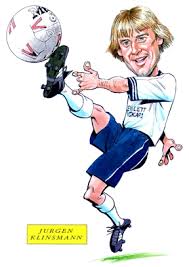
Showing posts with label Jurgen Klinsmann. Show all posts

Sunday, June 17, 2012

Can the Prospective Managers Do Better than Redknapp?

The removal of Harry Redknapp from Tottenham has resulted in the immediate drawing up of a list of potential managers to fill the vacancy.  Do their credentials suggest that any one of them is capable of doing better than the departing Redknapp and taking Spurs to the 'next' level?

The immediate favourite among the 'bookies' was the Everton manager, David Moyes, with Wigan's Roberto Martinez also highly regarded.  Other names which were prominent on the list were former Spurs player, Jurgen Klinsmann, Fabio Capello, Sven-Goran Eriksson and the man who is  looking increasingly like the next Tottenham manager, Andre Villas-Boas.  Other names to be mentioned in dispatches included Alan Pardew, Glenn Hoddle, Laurent Blanc, Didier Deschamps, Pep Guardiola and Slavin Bilic among others.

David Moyes
As I've blogged previously, Why David Moyes?  He has done a good job during ten years at Everton with a limited budget but has never won a trophy and on the one occasion that Everton did qualify for the Champions League, they failed to reach the Group stages and were then knocked out of the UEFA Cup prior to the group stages.

Moyes' teams are hard-working and have always been well-drilled and organised defensively but there has been a lack of the style of football that a Spurs' manager is expected to produce.  As Irving Scholar stated in his book, 'Behind Closed Doors', when considering a replacement for Keith Burkinshaw, the requirements for a Tottenham manager were 'winning and entertaining' football.

Roberto Martinez
Martinez has worked miracles to keep Wigan Athletic in the Premier League over the past three seasons when they have finished fifteenth, sixteenth and fifteenth.  In the past two seasons Wigan have been among the favourites for relegation until a late revival has saved them.  Only at the death have his teams produced the results.  They are capable of playing good football but have also suffered heavy losses.  As well as the 1 - 9 defeat at White Hart Lane in November, 2009 their final match of that season ended in an eight goal defeat at Chelsea.  The following season started with Wigan conceding ten goals in their opening two games at home to Blackpool and Chelsea.  They did turn it around with a single goal victory at Spurs in their next game.  Their survival in the Premier League was due to taking eight points from their final four matches of that season.  Hardly, impelling credentials for a Tottenham manager.

Jurgen Klinsmann
Klinsmann impressed in international management with Germany but only remained for two years.  His time with Bayern Munich was ended in less than a year due to a difference of opinion with the Board of Directors.  He has been manager of the American national team since last August.

Klinsmann has been mentioned before when Spurs have been looking for a new manager but the arguments against him then are still applicable.  He is always looking for new challenges as he did as a player, sampling football in different Leagues around Europe.  There would never be any certainty that he would see the job through and then his problem with the Bayern Board doesn't bode well for establishing a good working relationship with Daniel Levy and co.

Fabio Capello
He has an excellent record in club football with nine League titles in Italy and Spain.  However, he has never managed in Premier League and his time with England raised the problem of his communication skills due to his lack of fluency in English.  It would be a rather ironic appointment if the man Redknapp had expected to replace as England manager were to be his successor at White Hart Lane.


Sven-Goran Eriksson
Eriksson is another foreign manager with an exceptional record in club football across Europe.  He could have had the position at White Hart Lane in 1997 if Alan Sugar had known anything about him.  Harry Harris writes in his book, 'Hold the Front Page' that he received word that Sven-Goran Eriksson was interested in coming to England.
'I received a call from Bryan King on  my mobile.....He wondered how Spurs were getting on in their search for a new coach, and I told him, that they couldn't find the right candidate.
"How about Sven-Goran Eriksson?" ventured Bryan.
What a great idea, as he had a growing reputation built on steady progress through a number of European countries, such as Sweden, Portugal and Italy.......
Immediately I contacted Alan Sugar.  Naturally enough, the Spurs chairman hadn't heard of him, and really I didn't expect that he would have.  Alan suggested he would make some inquiries.....
The next day Alan called back and told me that he had consulted with people and Eriksson was not for Spurs."
Sugar went on to appoint Christian Gross.  Since his time as England team coach, Eriksson's dalliance with club football has been less impressive.  His time has passed.


Rafa Benitez
Benitez is another manager with vast experience and success in Spain taking Valencia to the title twice as well as winning the UEFA Cup.  In six years with Liverpool they were runners-up in the Premier League, won the FA Cup and took the ultimate prize in 2005 - winning the Champions League.

His teams are well prepared and were capable of playing attractive football.  He seemed to be at his best when preparing for the European competitions, especially when with Liverpool taking them to another Champions League Final in 2007.  The pressure of the rivalry with Manchester United seemed to get to him while at Anfield.

His time with Inter Milan was less fruitful where he stayed for only a season.  He took over from Jose Mourinho and was manager of Inter when they faced Spurs in two memorable games in the Champions League.  The master-tactician when faced with the pace of Gareth Bale seemed at a loss as to how to stop him.  Having been given fair warning of Bale's ability in the first game at the San Siro as Bale scored a hat-trick, Benitez failed to implement ant special arrangements to curtail his effectiveness in the second match at White Hart Lane.  Bale again reigned supreme as chants of 'Taxi for Maicon' rang around the ground during Spurs emphatic and well deserved 3 - 1 victory.

Alan Pardew, Frank de Boer and Glenn Hoddle and many others have also been mentioned along with Andre Villas-Boas who left Stamford Bridge in March after  a difficult time at Chelsea.


Andre Villas-Boas
After only a couple of days, rumours suggest that Villas-Boas has moved to the head of the vacancy list, to work along with Tim Sherwood as Director of Football.  Sherwood, the former Spurs player who was responsible for the Development squad at Spurs under Redknapp is the only member of the senior backroom staff to survive the cull.  Kevin Bond, Joe Jordan, Clive Allen and Les Ferdinand have all gone, leaving room for a new team to be appointed.

Villas-Boas had an excellent reputation for his work with Porto where his team won the League, Cup and Europa League in his one season in charge.  Porto went through the season undefeated and won the title by a twenty point margin.  This success attracted Chelsea to the young manager but his time at Stamford Bridge was problematic, where he had difficulties with the players, the owner and the media, eventually losing his post in March.

When Juande Ramos came to Tottenham he had an excellent reputation with Seville but it didn't work out in the Premier League.  Appointing Villas-Boas would be a huge gamble for Tottenham who are looking to get into the Champions League on a regular basis as well as win trophies.  Will he be given the time at White Hart Lane to get his new ideas across, that wasn't afforded to him at Stamford Bridge?  The press, opposing fans and supporters will be waiting for any signs of weakness as they did with a previous manager, Christian Gross, and Villas-Boas could find it difficult if he doesn't make an immediate impression as comparisons will be made with his predecessor.


Tottenham fans must also be willing to show patience if Villas-Boas were to be the chosen one.

Appointing a new manager is one of the most difficult tasks facing any Chairman.  The sudden departure of a successful manager makes it even more precarious a task that Daniel Levy has set for himself.


Google

Sunday, February 05, 2012

Spurs' Record against Liverpool at Anfield

Last season Spurs ended Kenny Dalglish's unbeaten home run since his return to Anfield as Liverpool manager and that remains his only home defeat.  Liverpool have shown recent improved form with last weekend's home victory over Manchester United in the FA Cup and holding City in the Carling Cup semi-final second leg match.  Their Premier League home record for this season shows seven draws and only four wins in eleven matches so Spurs will be looking to add to last year's success.
Pre-order Tottenham, The Glory-Glory Game Here: Use Code LH1

Up until 1985 Tottenham's annual trip to Anfield was associated with the sinking of the Titanic as Spurs had not won there since before that sad event.  This year, 15th April, 2012 marks the 100th Anniversary of the sinking of the Titanic on its maiden voyage from Southampton to New York.  A month earlier, Spurs had achieved their last win at Anfield on 16th March, 1912.

16th March, 1912  1st Div.  Won 2 - 1  Newman, Mason
Ahead of this game Spurs had won only twice since defeating Woolwich Arsenal 5 - 0 at White Hart Lane on Christmas Day.  There record included five defeats and four draws from eleven League and Cup games.  Spurs goals at Anfield were scored by Ernie Newman and Tom Mason.  This was Mason's only goal for Tottenham and neither player had lengthy careers with Spurs but events over the next 73 years finds them with a place in the Tottenham's history books. Spurs had taken a fifth minute lead with a header from Mason.  Newman added a second before half-time and although Liverpool scored early in the second half they couldn't get a second.  This was Spurs second success in three visits to Anfield, having won by the same score the previous season.

Seventy three years later, on the same date, 16th March, Spurs brought their terrible record at Anfield to an end.  During that time they had played 43 matches in League and Cup competitions, achieving 15 draws and 28 defeats.

16th March, 1985  1st Div.  Won 1 - 0  Crooks
Tottenham were challenging near the top of the 1st Division title but had lost in midweek at home to Manchester United.  It was actually their away record which was keeping them in the title race and they were undefeated in their previous 10 away League games with six victories.  They had lost at Anfield in the 4th Round of the FA Cup but on this occasion a garth Crooks goal with twenty minutes remaining earned them the three points.  Spurs finished the season in third place, level on points with Liverpool.

Over the next 27 years Tottenham have won at Anfield on another five occasions in League and Cup:

Premier League Record at Anfield
P  19  W  2  D  5  L  12  For  17  Ag  38

Last Season
May, 2011  PL  Won 2 - 0  Van der Vaart, Modric (pen)
Liverpool and Spurs were both in contention for a place in the Europa League with two matches tpo play at the end of the season.  Ledley King made a surprise return to the Tottenham defence having been absent since October and helped keep a clean sheet for the first time in ten games.  Rafael van der Vaart gave Spurs an early lead and Luka Modric's second half penalty helped secure the victory and Liverpool's first home defeat since Kenny Dalglish's return as manager.  This was only Spurs second Premier League win at Anfield.

Jan. 2010  PL  Lost 0 - 2
Dirk Kuyt gave Liverpool an early lead but the determining moment in the game came just after half-time when the referee, Howard Webb, who else, disallowed a Jermain Defoe goal for offside, a controversial decision.  A last minute penalty secured victory for the home side.

Oct. 2007  PL  Draw 2 - 2  Keane (2)
Liverpool scored early but Robbie Keane equalised right on half-time.  He then put Spurs ahead two minutes into the second half and looked to have secured the win until a last minute goal snatched it away.

April, 2005  PL  Draw 2 - 2  Edman, Keane
Erik Edman was the scorer of one of the best goals by a Spurs player at Anfield.  His early strike from almost forty yards giving the goalkeeper no chance.  Spurs held the lead until just before half-time but regained the advantage after ten minutes of the second half through Robbie Keane.  Liverpool were level eight minutes later.

Nov. 1998  LC  Won 3 - 1  Iversen, Scales, Nielsen
This victory enabled Spurs to continue on their Road to Wembley and success in the Final of the Worthington Cup against Leicester City.

Mar. 1995  FAC  Won 2 - 1  Sheringham, Klinsmann
Everyone was beginning to think that this was going to be Tottenham's year for the FA Cup.  they had shown great determination to win at Anfield with Jurgen Klinsmann's late goal.  Liverpool had taken the lead late in the first half but Teddy Sheringham brought them level just before the interval.  A draw was looking the most likely result when with two minutes remaining Sheringham put Klinsmann through to score the winner.  Sadly, Everton ended Spurs' Wembley dreams in the semi-final.

Aug. 1993  PL  Won 2 - 1  Sheringham (2) (1 pen)

Oct. 1986  1st Div.  Won 1 - 0  Allen, C.

Ledley King made his debut for Spurs at Anfield in May, 1999, coming on as a substitute in a 2 - 3 defeat.  A Jamie Carragher own goal and a Steffan Iversen gave Spurs the lead at the interval but Liverpool came back in the second half with Jamie Redknapp scoring their first from the penalty spot.
King had come on at half-time in place of Stephen Clemence.

Mar. 1973  1st Div.  Draw 1 - 1  GilzeanOne of the most memorable performances by a Spurs player at Anfield was in a 1 -1 draw in 1973 when Pat Jennings saved two penalties to deny Liverpool.

Keegan had seen the first saved, Jennings diving to his right to palm away.  Smith put the next one to Jennings's left, with similar results.  There is a photograph of Jennings springing up from his second penalty save, punching the air with one hand.  The referee looks on, grinning wildly in sheer disbelief.  On the turf, down on his knees, is Smith, hammering the ground with both fists in impotent rage.

Alan Gilzean had scored the opener, but Keegan eventually put the ball past Jennings with, of course, a mishit, deflected shot.

Spurs who defeated Liverpool by four goals at White Hart Lane in September will hope to reduce the gap on second placed Manchester United to three points with a win at Anfield and secure a second consecutive win at the ground, something they haven't achieved since those two seasons immediately before the sinking of the Titanic.


Google

Thursday, January 26, 2012

Tottenham's Cup Record against Watford

Tottenham's visit to Vicarage Road to play Watford in the FA Cup 4th Round tie is the first occasion that Watford have had home advantage over Spurs in the FA Cup.  The clubs have met previously on three occasions at White Hart Lane and at a neutral venue for a semi-final clash.  Spurs have played at Watford in the League Cup in three matches.  A further FA Cup tie was played at Spurs' old Northumberland Park ground when Watford were known as West Herts.

Carling Cup 5th Round
Spurs last game at Watford was in the Carling Cup in December, 2008 at the 5th Round stage.  They progressed to a semi-final tie against Burnley with a 2 - 1 success through goals from Roman Pavlyuchenko and Darren Bent.

Spurs found themselves a goal behind within fifteen minutes as Watford mounted sustained early pressure.  They drew level on the stroke of half-time with a Pavlyuchenko penalty following a foul on Jermaine Jenas.  Spurs scored the winner with fifteen minutes remaining when substitute Bent latched on to a ball from Pavlyuchenko to score with  a low shot.

FA Cup 3rd Round
The last meeting between the two clubs in the FA Cup was in January, 1999 when Spurs won 5 - 2 at White Hart Lane.  Watford who were in the 1st Division at the time took the lead in the opening minute.  Steffan Iversen equalised on ten minutes as Spurs scored three times in seven minutes.  Three minutes later Darren Anderton scored with a penalty for handball following a free-kick awarded for a foul on David Ginola and then Iversen added his second on seventeen minutes.  Watford showed spirit and pulled a goal back after half and hour but Allan Neilsen restored Spurs two goal advantage three minutes before the interval.

It was not until four minutes from time that Ruel Fox completed the scoring with Spurs' fifth.  Two former Spurs players were included among the Watford substitutes that day, goalkeeper Chris Day and Ronnie Rosenthal.  Rosenthal came on at half-time, receiving a warm welcome from the Tottenham faithful.

League Cup (Coca Cola Cup) 2nd Round
This tie was played over two legs with the first game at Watford in September, 1994.  It marked Jurgen Klinsmann's debut in Cup football in England and he didn't disappoint scoring a first half hat-trick on the ground where he had made his first Spurs appearance in a pre-season friendly the previous August.

Watford took the lead in the opening seconds but Darren Anderton levelled with a shot from the edge of the penalty area.  Then Jurgen Klinsmann completed his hat-trick before half-time to give Ossie Ardiles' attacking team the advantage.  After half-time Watford pulled a goal back before Teddy Sheringham restored their three goal lead.  Ian Walker then conceded a penalty but saved it before Ilie Dumitrescu scored Spurs sixth, only for Watford to pull another goal back through a Gary Mabbutt own goal.

The second leg at White Hart Lane a fortnight later in October, 1994 was just as exhilerating as Watford came out victorious by 3 - 2.  Spurs, however, progressed to the next round with an aggregate win of 8 - 5.  Watford went ahead after fifteen minutes but Nicky Barmby who missed the first match equalised after half an hour.  Watford regained the lead early in the second half but Klinsmann again drew Spurs level only for the visitors to score the winner fifteen minutes from time.  This was Spurs fourth consecutive home defeat and Ardiles was under increasing pressure.

FA Cup Semi-Final
Spurs were progressing serenely towards the Wembley Final when they met Watford at the FA Cup semi-final stage at Villa Park in April, 1987.  The match proved remarkably easy for Spurs who were facing a Watford side who had to find emergency goalkeeping cover due to injury.  The 4-1 victory did not flatter Spurs as David Pleat’s side continued their good form and won through goals from Steve Hodge (2), Clive Allen and Paul Allen. Coventry City were their unexpected opponents in the Final and unfortunately that match didn't go as expected.

League Cup 2nd Round
In September, 1975 Spurs visited Vicarage Road for a Cup match for the first time.  They won against the 4th Division side through the only goal scored by Chris Jones.  Having avoided relegation with victory over Leeds United in the last game of the previous season, Terry Neill's team, in his only full season in charge of the club, progressed to the semi-final stage where they lost out to Newcastle United.

FA Cup 3rd Round
In January, 1939 Spurs were playing in the 2nd Division while Watford were in the 3rd Division (South).  An emphatic win at White Hart Lane saw Spurs create another 'first' to include in their record books.  It was the first time that numbers were worn on the players' shirts, something which the Spurs directors had been campaigning for over a considerable period of time.

The Spurs goals were scored by Ralph Ward (pen), Fred Sargent, Willie Hall (2), Andy Duncan, Les Miller (2).

FA Cup 2nd Round
Spurs were the Cup holders when the clubs met in January, 1922 with Spurs in the 1st Division and  Watford in the 3rd Division (South).  Tottenham had overcome Brentford in the 1st Round and a Bert Bliss goal at White Hart Lane was sufficient to see them progress on this occasion.  Their defence of the FA Cup came to an end in the semi-finals when they lost to Preston North End in controversial circumstances.

Spurs first FA Cup tie was in October, 1894 when they met West Herts at their old Northumberland Park ground.  Four years later, in 1898, West Herts and Watford St. Mary's merged to form Watford FC.  Spurs won 3 - 2 with goals from Peter Hunter and Donald Goodall (2) and Tottenham's experience with the FA Cup had commenced.


Google

Saturday, September 10, 2011

Adebayor Scores on his Tottenham Debut

Adebayor - No: 11

Adebayor celebrates his debut goal
In the 67th minute of his debut for Tottenham against Wolves at Molineux, Emmanuel Adebayor collected a through ball from Scott Parker and coolly scored his first goal for his new club.  This set Spurs up for their first Premier League win of the season and made him the eleventh Tottenham player to score on their Premier League debut.

Who else is on that list?

Sol Campbell: (Dec. 1992) In the first season of the Premiership Campbell made his debut as a late substitute against Chelsea at White Hart Lane. His goal was a late consolation in a 2-1 defeat. Campbell went on to captain Spurs to a Worthington Cup success at Wembley against Leicester City in 1999 but he will forever be despised by Spurs fans for the way he left the club in 2001 on a Bosman free to sign for the club's near neighbours and greatest rivals, Arsenal.

Ronnie Rosenthal: (Feb. 1994) Battling against relegation Ossie Ardiles signed Rosenthal to bring some experience to the team which was struggling to score goals. In his debut at home to Sheffield Wednesday Rosenthal scored but it didn't prevent Spurs losing 1-3. the highlight of Rosenthal's career with Spurs was the hat-trick he scored against Southampton in the FA Cup in 1995. Spurs were two down at half-time but Rosenthal came on as a substitute and scored twice to take the game to extra time. He completed his hat-trick (three tremendous goals) to give Spurs an improbable 6-2 victory.

Jurgen Klinsmann: (Aug. 1994) (pictured) Spurs were in deep trouble having been severely punished by the Football Association for financial irregularities. Chairman, Alan Sugar had managed to persuade Klinsmann to join Spurs and his presence gave Spurs an immediate boost and an opening day success against Sheffield Wednesday at Hillsborough. Klinsmann scored in a 4-3 victory, introduced his 'dive' celebration and was carried off injured on his debut. Klinsmann formed an exciting goal scoring partnership with teddy Sheringham but unfortunately it didn't produce any silverware for the club and he departed at the end of the season. His later return was not as effective although he scored four vital goals against Wimbledon to save spurs from relegation under Christian Gross.

Dean Richards: (Sept. 2004) Signed from Southampton by Glenn Hoddle, defender Richards scored against Manchester United as Spurs took a three goal lead in the first half. However, that was as good as it got as after half-time United stormed back at White Hart Lane to win 5-3. Richards career at spurs was blighted by injury.

Fredi Kanoute: (Aug. 2003) Signed from West Ham United during the summer he made his debut at home to Leeds United. His substitute appearance in the first home game of the season ensured Spurs' 2-1 victory. A player of great technique, Kanoute's languid style divided supporters but he scored many important goals before his departure to Seville in 2005. After his departure some supporters came to realise what he brought to the team.

Mbulelo Mabizela: (Oct. 2003) Signed by Spurs following their summer tour to South Africa Mabizela made his debut as a late substitute at Leicester City. He scored the winning goal in the 2-1 success but failed to build on that promising start to his Spurs career.

Jermain Defoe: (Feb. 2004) Signed from West Ham United, Defoe was an instant hit scoring early on his debut against Portsmouth at White Hart Lane as Spurs won 4-3. A regular goal scorer he left for Portsmouth in January, 2008 but returned a year later.

Mido: (Feb. 2005) A loan signing Mido made an impressive debut against portsmouth, scoring twice. He became an important member of Martin Jol's team which just missed out on a Champions League place. When his application and effort were right he was good and scored vital goals but he struggled to maintain this endeavour.

Gilberto: (Mar. 2008) A disappointing signing, the Brazilian rarely showed his true ability but scored in a 4-0 victory, having come on as a substitute against West Ham United at White Hart Lane. He had played his first game for Spurs in a UEFA Cup tie against PSV Eindhoven in mid-week but it was his error which had given the visitors the only goal of the game.

Sebastien Bassong: (Aug. 2009)  The opening day of the new season and scored with a header from a corner against Liverpool at White Hart Lane.  This set Tottenham up for a 2 - 1 win and a run that was to be their best start to the season since the famous 'Double' season of 1960 - 61.

Pre-Premier League Goal Scoring Debuts

Many players have scored on their debut prior to the creation of the Premier League. That list of players include many legends:
  • Jimmy Greaves (a hat-trick against Blackpool (h))
  • Martin Chivers (2 at Sheffield Wednesday)
  • Colin Lee (4 in a 9-0 demolition of Bristol Rovers at White Hart Lane in Spurs last season in the old Second Division)
  • Richy Villa at Nottingham Forest
  • Garth Crooks against Nottingham Forest


Google

Thursday, August 12, 2010

Spurs' Summer Expectations Shattered Once Again.

Ardiles - World Cup Winner

The early summer expectations of a World Cup that would throw up a host of foreign players who would enhance the Premier League were quickly dashed as the realisation dawned very early in the competition that South Africa 2010 was a rather poor and disappointing vintage to offer to the world.  Tottenham Hotspur have benefitted in the past from World Cup signings - they set high standards when Keith Burkinshaw returned to Argentina to sign World Cup winners, Ossie Ardiles and Ricky Villa.  In 1984 Alan Sugar pulled a rabbit out of the hat with the unexpected signing of Germany's Jurgen Klinsmann but on other occasions the stars of the World Cup have disappointed when faced with the rigours of English football.  This year there were few who did themselves much good in the shop window of the World Cup.

Every summer Spurs fans hope for an early resolution to all transfer negotiations as the manager, with the Chairman's assistance, endeavours to strengthen the Tottenham team for the following season.  The reasoning being that on the resumption of training all the new players will be in place and the work of preparing for the new season can commence in earnest.  However, sadly, once again, this has proved to be a forlorn and false hope as, to date, no new signings have appeared at White Hart Lane.  The only signing of note has been the acquisition of the young Brazilian midfield player, Sandro, but he remains in his homeland and is not expected to be available until September. 
The rumour mill has once again been in full swing with Spurs centre field for every conceivable target but no-one has signed on the dotted line and held up the lilywhite shirt at White Hart Lane.

For many years as Spurs have chased possible transfer targets, the lack of first, European football, and then Champions League football has always been held up as a reason why players have been reluctant to commit themselves to Spurs.  But now with Champions League football beckoning, players still show a reluctance to come to Tottenham.  In past years all we could do was watch as our star players went off to pastures new to fulfill their dreams of playing for the top clubs in the top competitions - Sol Campbell deserted Tottenham for our closest rivals, Arsenal, Teddy Sheringham, Michael Carrick and Dimitar Berbatov couldn't wait to get to Old Trafford while Robbie Keane had to sign for his boyhood team, Liverpool.  Spurs couldn't offer those players the opportunity to play at the highest level so there was nothing the club could do but release them with their best wishes and accept the transfer fees to swell the coffers while we, the fans, felt betrayed and disconsolate.  However, now things have changed, Spurs have access to the Champions League while Liverpool are consigned to the Europa League, that should make a difference.  But No - Spurs are still struggling to make those important signings while Liverpool have managed to hold on to their stars - Steven Gerrard and Fernando Torres and have persuaded Joe Cole to move north to Anfield rather than move to Tottenham.  So as Manchester City and Liverpool have proved, players aren't just interested in the playing opportunities, they're very interested in the money on offer and will go to wherever they get the best salary.  Perhaps, Mr Levy will have to reconsider his financial restrictions where transfer fees and salaries are concerned if Tottenham Hotspur are going to become one of the big players in the Premier League as well as in Europe.  No-one wants Spurs to spend foolishly or offer extravagant salaries but to achieve greatness there will have to be a loosening of the purse strings to attract quality players to the club.

With less than three weeks remaining of this very quiet transfer window, it is to be hoped that any signings will improve the quality of the team and not just be a signing for the sake of it - in the past Spurs have suffered through Mr Levy's desire to shop at 'last-minute.com'.  Late, hasty purchases rarely achieve great success.  Spurs need better than that if they are to maintain the progress achieved by Harry Redknapp in the past two years.


Google

Spurs' Goal Scoring Debutantes in Premier League


Sixteen players have scored for Tottenham Hotspur on their debut in the Premier League. New signing Tanguy Ndombele joins an interesting group of players - some who are fondly remembered at the club, while others have been long forgotten. 
(Up-dated: Aug. 2019) 

Sol Campbell: (Dec. 1992)* In the first season of the Premiership Campbell made his debut as a late substitute against Chelsea at White Hart Lane. His goal was a late consolation in a 2-1 defeat. Campbell went on to captain Spurs to a Worthington Cup success at Wembley against Leicester City in 1999 but he will never be forgiven by Spurs fans for the way he left the club in 2001 on a Bosman free to sign for their near neighbours and greatest rivals, Arsenal.

Ronnie Rosenthal: (Feb. 1994) Battling against relegation Ossie Ardiles signed Rosenthal to bring some experience to the team which was struggling to score goals due to a long-term injury to Teddy Sheringham. In his debut at home to Sheffield Wednesday Rosenthal scored but it didn't prevent Spurs losing 1-3. The highlight of Rosenthal's career with Spurs was the hat-trick he scored against Southampton in the FA Cup in 1995. Spurs were two down at half-time but Rosenthal came on as a substitute and scored twice to take the game to extra time. He completed his hat-trick (three tremendous goals) to give Spurs an improbable 6-2 victory.

Jurgen Klinsmann: (Aug. 1994) (pictured) Spurs were in deep trouble having been severely punished by the Football Association for financial irregularities. Chairman, Alan Sugar had managed to persuade Klinsmann to join Spurs and his presence gave Spurs an immediate boost and an opening day success against Sheffield Wednesday at Hillsborough. Klinsmann scored in a 4-3 victory, introduced his 'dive' celebration and was carried off injured on his debut. Klinsmann formed an exciting goal scoring partnership with Teddy Sheringham but unfortunately it didn't produce any silverware for the club and he departed at the end of the season. His later return was not as effective although he scored four vital goals against Wimbledon to save Spurs from relegation under Christian Gross.

Dean Richards: (Sept. 2004) Signed from Southampton by Glenn Hoddle, defender Richards scored against Manchester United as Spurs took a three goal lead in the first half. However, that was as good as it got as after half-time United stormed back at White Hart Lane to win 5-3. Richards career at Spurs was blighted by injury.

Fredi Kanoute: (Aug. 2003)* Signed from West Ham United during the summer he made his debut at home to Leeds United. His substitute appearance in the first home game of the season ensured Spurs' 2-1 victory. A player of great technique, Kanoute's languid style divided supporters but he scored many important goals before his departure to Seville in 2005. After his departure some supporters came to realise what he brought to the team.

Mbulelo Mabizela: (Oct. 2003)* Signed by Spurs following their summer tour to South Africa, Mabizela made his debut as a late substitute at Leicester City. He scored the winning goal in the 2-1 success but failed to build on that promising start to his Spurs career.

Jermain Defoe: (Feb. 2004) Signed from West Ham United, Defoe was an instant hit scoring early on his debut against Portsmouth at White Hart Lane as Spurs won 4-3. A regular goal scorer he left for Portsmouth in January, 2008 but returned a year later and was part of the team which took Tottenham into the Champions League under Harry Redknapp. By the time of his departure in February, 2014, he had made 363 appearances, scoring 143 goals in all competitions. At that time he was Tottenham's 5th highest goalscorer and their highest scorer in European competitions. Harry Kane has since overtaken him in both of those rankings.

Mido: (Feb. 2005) A loan signing Mido made an impressive debut against Portsmouth, scoring twice. He became an important member of Martin Jol's team which just missed out on a Champions League place. When his application and effort were right, Mido was good and scored vital goals but he struggled to maintain his fitness and this endeavour.

Gilberto: (Mar. 2008)* A disappointing signing, the Brazilian rarely showed his true ability but scored in a 4-0 victory, having come on as a substitute against West Ham United at White Hart Lane. He had played his first game for Spurs in a UEFA Cup tie against PSV Eindhoven in mid-week but it was his error which had given the visitors the only goal of the game.

Sebastien Bassong: (Aug. 2009) His headed goal against Liverpool on the opening day of the 2009 - 10 season made him the tenth Spurs' player to score on their Premier League debut.

Danny Rose: (Apr. 2010) He made his league debut against Arsenal, scoring the first goal of the match after ten minutes as Tottenham won 2–1 in the Premier League on 14 April 2010. The goal was subsequently described as "a volley so thunderous that you could hear the whack off his boot above the din of the raucous crowd" in The Times. Rose won Goal of the Season, with votes run by Sky Sports and by the Tottenham website.

Emmanuel Adebayor: (Sept. 2011) Having joined Spurs on loan from Manchester City, in the 67th minute of his debut for Tottenham against Wolverhampton Wanderers at Molineux in September, 2011, Adebayor collected a through ball from Scott Parker and coolly scored his first goal for his new club. This set Spurs up for their first Premier League win of the season and made him the twelfth Tottenham player to score on their Premier League debut.

Moussa Dembele: (Aug. 2012) A match in which Spurs were struggling came to life in the second half when substitute Moussa Dembele scored from the edge of the penalty area. Unfortunately, it wasn't a winning debut as battling Norwich City levelled the scores with a few minutes remaining.

Roberto Soldado: (Aug. 2013) A second half penalty as Spurs visited London rivals, Crystal Palace, secured the points for Tottenham. The penalty came four minutes after the restart when a cross by Lennon was handled. Soldado stepped up confidently to score on his debut and set Spurs on their way with the only goal of the game.

Eric Dier: (Aug. 2014) Having joined Tottenham less than two weeks earlier, the 20-year-old Dier made an immediate impact at the club – impressing in central defence and also with his coolness when scoring the late goal. Played in by Harry Kane in the 92nd minute, Dier took the ball wide of the advancing West Ham goalkeeper and placed the ball into the open goal. With the goal coming so late in the game it was guaranteed to grab the headlines as it provided Mauricio Pochettino with a winning start to the season for Spurs.

Tanguy Ndombele: (Aug. 2019) Tottenham's record signing, costing £55m, made his debut against Aston Villa on the opening day of the season at the Tottenham Hotspur Stadium. A goal behind from the 9th minute and looking set to lose their first game, it was in the 73rd minute that Ndombele received the ball from Lucas Moura and fired in a shot from outside the box, to equalise and calm the worried Spurs' supporters. This lifted the team and the fans as Tottenham went on to win 3-1 with two goals in four minutes from Harry Kane as the game drew to a close.

* Players who made their debut as a substitute

Pre-Premier League Goal Scoring Debuts

Many players have scored on their debut prior to the creation of the Premier League. That list of players include many legends:
  • Jimmy Greaves (a hat-trick against Blackpool (h))

  • Martin Chivers (2 at Sheffield Wednesday)

  • Colin Lee (4 in a 9-0 demolition of Bristol Rovers at White Hart Lane in Spurs last season in the old Second Division)

  • Ricky Villa at Nottingham Forest

  • Garth Crooks against Nottingham Forest
Google

Friday, August 24, 2007

Spurs in History - 24th August

24th August, 1994

Spurs 2 Everton 1

Jurgen Klinsmann's Home Debut

The atmosphere was electric as 24,553 spectators packed into WHL for Jurgen Klinsmann’s home debut. The reduced capacity was due to the ground redevelopment and Spurs could have filled the stadium twice over such was the demand for tickets.

Jurgen, as in his debut didn’t fail to deliver. The crowd had come to see him and within twenty two minutes he had put Spurs ahead with a spectacular volley. Thirteen minutes later he had added a second.

On half time Spurs won a penalty and everyone in the ground was willing Klinsmann to take it. Everyone, except Teddy Sheringham who elected to take it and ballooned it over the bar.

In the second half Everton scored and Spurs had to hang on to the end to achieve the win their play deserved.

Klinsmann showed what he was capable of in his first two games but the difficulty of achieving a balance between defence and attack was to bring about Ossie Ardiles’ departure from White Hart Lane.


Google


Tuesday, August 21, 2007

No Jurgen! Not the Man for Tottenham Hotspur

Jurgen Klinsmann as Spurs boss?


Jurgen Klinsmann is one of the names being put forward to replace Martin Jol at White Hart Lane but the club has already been down that road. Ossie Ardiles and Glenn Hoddle, former star players returned to the club as manager but with little success.

White Hart Lane is NOT the place for Jurgen Klinsmann. Spurs have tried that before and with disastrous results. They've brought in former players to manage the club to please the fans and it hasn't worked. Indeed, it all ended in tears.


Alan Sugar brought Ossie Ardiles from West Bromwich Albion in the aftermath of his fall-out with Terry Venables. He knew that he had to find someone whom the fans would accept and Ardiles fitted the bill. Ardiles' first season was a disaster with the club only avoiding relegation with a game to spare.


The following summer was a great time for Spurs as Ardiles signed Jurgen Klinsmann, Ilie Dumitrescu and Gica Popescu and the season started with a flourish of exciting, attacking football. However, as autumn turned to winter, the attacking flair envisaged by Ardiles couldn't outscore the deficiencies of the defence, so club and manager parted company after 18 months. Ardiles as a player was a hero to all Spurs supporters, but as a manager he failed in the Premiership.


Move forward six years and the club’s new owners are looking to impress the supporters and get them on their side. They remove the unpopular George Graham and replace him with every Spurs fans' favourite - Glenn Hoddle. An encouraging start is followed by twelve months of misery before the Board admit their mistake and remove Hoddle - it simply hasn't worked.


Everyone at Tottenham Hotspur wanted Hoddle to succeed as manager but he failed to take the club forward. Similarly to Ardiles, he had little more than 18 months as manager. Both Ardiles and Hoddle were worshipped by the supporters and such was their standing as players that the fans still remember them favourably, overlooking their management shortcomings.


Klinsmann falls into the same category. He was a great favourite as a player, although he was only at White Hart Lane for a short time in comparison to either Ardiles or Hoddle. But he could so easily fall short as a manager. His reputation in management is high following his handling of the German team in the World Cup. However, he has no experience as a manager or coach at club level which demands day on day involvement with the players and officials. Would Klinsmann give the long-term commitment needed for such a position?


Klinsmann seems to enjoy the American lifestyle of California - would he be tempted to return to the grey skies of Tottenham? It would appear to be unlikely and a tremendous gamble to put all your faith in someone untried at this level.
In the World Cup, Klinsmann was working with the best players Germany had available to him. Would he have the patience and temperament to work with lesser players? Would he have the desire to cope with all the demands of the players on a daily basis? His man-management skills would be sorely tested.


Klinsmann achieved a great deal with Germany and was rightly praised for his innovation and the style with which his country played throughout the tournament. However, that was for a short period. Would he be able to continually motivate players through a long season and would his natural enthusiasm extend to a wet November night at Grimsby for a Cup game?


As a player, Klinsmann enjoyed new challenges - he played in different countries and then moved on in search of something new. As coach to the German team he has shown the same ideology, resigning at the end of the tournament and looking for a fresh challenge. As manager or coach of a club side, there has to be that longer-term commitment and it’s uncertain whether Klinsmann would be prepared to make it.


His reputation at White Hart Lane is based on 18 months as a player. As a manager, he mightn't even last that long. In the short-term, it would be a tremendous coup to recruit Jurgen as manager/coach. The move would be surrounded with fantastic media hype but it is uncertain that he would be a long-term solution to the club's managerial problems.


Many international managers complain that they they miss the day-to-day involvement with the players that is part of club management. Klinsmann, on the other hand, seems ideally suited to that international management role as it allows him greater freedom to be involved in other projects. Spurs’ supporters wouldn't want to see Klinsmann come to Tottenham and suffer as both Ardiles and Hoddle did before him. Spurs supporters want to remember him as the player he was and not as a manager who has failed to achieve what he and the fans have been hoping for.


Google


Monday, August 06, 2007

Spurs in History - 6th August

6th August, 1994

Watford 1 Spurs 1 (Pre-season Friendly)

Since the announcement that Jurgen Klinsmann had joined the club, this match was eagerly awaited.

Klinsmann made his Spurs' debut and Watford were the fortunate beneficiaries of media attention and clamour for tickets for what would otherwise have been another run of the mill pre-season friendly.

Jurgen Klinsmann didn’t score in the game but his contribution was sufficient to show that Spurs had signed an outstanding player.
Spurs' goal was scored by Teddy Sheringham.

Google


Monday, July 30, 2007

Spurs in History - 29th July

29th July, 1994

Spurs - A Transfer Coup.


A transfer coup to match the Argentine success of 1978, Chairman, Alan Sugar completed the signing of German World Cup star, Jurgen Klinsmann.


Sugar was determined to lift morale at the club following the unjust F.A. punishment and this signing had the desired effect. It brought Spurs to the forefront of the football and news media and there was fantastic demand for tickets for Spurs games, home and away.


Klinsmann joined Anderton, Sheringham, Barmby and Dumitrescu to form manager, Ossie Ardiles' famous five attacking formation. However, while exciting going forward the team lacked co-ordination in defence and Ardiles' stay was short lived.


It was the arrival of Gerry Francis in November which brought some structure to the team and Klinsmann was able to be seen at his best in what proved to be an exciting team to watch.

Unfortunately, his stay was for only one season. With Spurs unable to offer European football, Klinsmann returned to Germany with Bayern Munich.

Google


Monday, July 02, 2007

Spurs in History - 8th July

8th July, 1990

In the World Cup Final in Italy, Germany defeated Argentina by one goal to nil.

A member of the German team was Jurgen Klinsmann who four years later would sign for Spurs at a time when they were at their lowest ebb following the severe punishment imposed by the Football Association.

In that one season at White Hart Lane he would lift Spurs to unexpected heights but was to leave them dashed as he moved on twelve months later.


Google


Spurs in History - 7th July

7th July, 1994

Vinny Samways who had joined the club as an apprentice in 1985, handed in a transfer request. He claimed that he wanted a new challenge but the punishment imposed by the Football Association was obviously making the club an unattractive proposition for players at the club as well as for players the manager might try to sign.

He eventually signed for Everton and ironically was present at White Hart Lane as Jurgen Klinsmann inspired Spurs to victory over Everton in the first home match of the season a few weeks later.


Google


Saturday, June 30, 2007

Spurs in History - 30th June

30th June, 1995

Chris Armstrong Signs for Tottenham Hotspur

Chris Armstrong was signed from Crystal Palace for a fee of £4.5 million to become Spurs most expensive player.

He had been bought to replace Jurgen Klinsmann who had returned to Germany after only one season at White Hart Lane. The initial reaction was not very positive with newspaper reports of Teddy Sheringham being less than complimentary about his new striking partner.

However, he did form a very effective partnership with Sheringham but he had an impossible task to try to replace Klinsmann in the hearts of the supporters.

His career at Spurs ended when he was released in 2002 following a long period of injury.


Google


Thursday, May 10, 2007

Spurs in History - 10th May

10th May, 1998

Spurs 1 Southampton 1 Premiership

Job completed, Spurs said farewell to Jurgen Klinsmann for the second time in three seasons. This second period had not brought the same success as previously but he had scored six goals in Spurs final three games of the season which had helped ensure Premiership survival.
Klinsmann signed off from White Hart Lane by scoring Spurs equaliser.

Also leaving Tottenham that day were Gary Mabbutt and David Howells who had served Spurs loyally over many seasons.

On this day in 1995, a former player became immortalised in Spurs folklore with his winning goal in the last minute of extra time for Real Zaragossa in the European Cup Winners’ Cup Final against Arsenal – it was, ‘Nayim from the halfway line.’


Google


Wednesday, May 02, 2007

Spurs in History - 2nd May

2nd May, 1998

Wimbledon 2 Spurs 6 Premiership
 Scorers: Klinsmann (4), Ferdinand, Saib

Jurgen Klinsmann
Survival and what a way to do it!  After a long and difficult season Spurs were still fighting to retain their place in the Premiership.   Christian Gross’ appointment had not been successful and there was discontent among the players over his style of management.


The return of Jurgen Klinsmann had not brought about the hoped for revitalisation of the team and he had struggled to make a major impact in his second spell at White Hart Lane.  However, Klinsmann rectified that situation in just one game.  Spurs had taken an early lead through Les Ferdinand after a shot from David Ginola had hit the post.  They were, however, a goal behind as half time approached, until Klinsmann equalised. 

In the second half Klinsmann scored another three goals inside five minutes and then set up the sixth goal for Moussa Saib.  While Klinsmann scored the goals and claimed the headlines, David Ginola was unplayable that day, creating so many problems for the Wimbledon defence that future Tottenham player, Ben Thatcher was sent off.

Team: Walker; Carr, Calderwood, Campbell, Nielsen; Fox (Saib), Anderton, Berti, Ginola; Ferdinand (Armstrong), Klinsmann.


Google


Monday, April 23, 2007

Berbatov – A Player for a Season at Tottenham?

Dimitar Berbatov


I do hope I’m proved wrong but my over-riding impression after watching Spurs snatch a draw against Arsenal at White Hart Lane with Jermaine Jenas’ late equaliser is that Dimitar Berbatov will not be there next year. He has brought a class to Spurs that has been missing for some considerable time, he has lifted the team as Jurgen Klinsmann did all those years ago but ultimately the short-comings of those around him will lead to his departure.

Throughout the game and over the past number of matches there has been evidence for all to see that Berbatov is a player who is so frustrated.

Frustrated at the lack of support through the team’s style of play where he so often, even at home, is the lone striker.

Frustrated at the inability of the other players to provide a pass that will create a meaningful chance for him to strike on goal.

Frustrated at other players not reading the game and moving into space to receive a forward pass.

Frustrated at the lack of support as he chases across the field trying to close defenders down and then discovers that there’s no-one backing him up.

Frustrated with his own play that he hasn’t been able to get away from the three defenders marking him. When a defender takes the ball from him he does a jump of frustration or looks to the sky in annoyance. Opposition players know that Spurs play so deep that they can isolate Berbatov and limit his contribution.

Frustrated at refereeing decisions which go against him.

I’m not suggesting that Berbatov is playing to get away or that he’s not giving his all throughout a game. He created the opportunity for the first goal when winning the corner and he celebrated both goals with the same enthusiasm as everyone else but it’s been a long season and the lack of success and the disappointments of the last few weeks are clearly getting to him.

A telling image from the final moments of the game - with Spurs again looking unlikely to get any reward for their efforts - was Robinson wanting to take a free kick on the edge of his penalty area and desperately trying to attract Berbatov’s attention. Berbatov was just walking slowly forward, head down not looking to see what was happening - it was if he felt he had done all that he could on the day and had nothing left to give.

Of course, Berbatov can’t just announce that he’s going as Klinsmann did in 1995 but if a top club makes it known that they’re interested and offers a big transfer fee what chance have Spurs of keeping him? If an offer comes where the player will have the opportunity to play at the highest level in the Champions League, with the opportunity to play alongside other top class players, with the chance to win silverware and with a big salary on offer – he can’t be blamed for looking enviously in their direction.

What can Tottenham offer against that? Possible UEFA Cup competition and there’s no guarantee that that will be achieved and then more of the same just like this year. It was Spurs’ inability to provide European football that gave Klinsmann the opportunity to move on and it could happen again with Berbatov. The next four games will have such a significant bearing on Tottenham’s and Berbatov’s future.

As I said at the start I do hope I’m wrong – Spurs need Berbatov next season, not money in the bank or to spend on lesser players. Remember we replaced Jurgen Klinsmann with Chris Armstrong and Teddy Sheringham was unimpressed. Berbatov would be equally difficult to replace. Spurs’ future depends on keeping their best players and adding to the quality in order to make improvements year on year. It will be another long summer in the transfer market.

Google


Monday, April 16, 2007

Klinsmann to Boss Spurs - No!

Jurgen Klinsmann as Spurs boss? Here's why it wouldn't work
It has been suggested that the former Spurs hero should return to White Hart Lane as manager. But the club has already been down that road with Ossie Ardiles and Glenn Hoddle - with little success.

White Hart Lane is NOT the place for Jurgen Klinsmann. Spurs have tried that before and with disastrous results. They've brought in former players to manage the club to please the fans and it hasn't worked. Indeed, it all ended in tears.

Alan Sugar brought Ossie Ardiles from West Bromwich Albion in the aftermath of his fall-out with Terry Venables. He knew that he had to find someone whom the fans would accept and Ardiles fitted the bill. Ardiles' first season was a disaster with the club only avoiding relegation with a game to spare.

The following summer was a great time for Spurs as Ardiles signed Jurgen Klinsmann, Ilie Dumitrescu and Gica Popescu and the season started with a flourish of exciting, attacking football. However, as autumn turned to winter, the attacking flair envisaged by Ardiles couldn't outscore the deficiencies of the defence, so club and manager parted company after 18 months. Ardiles as a player was a hero to all Spurs supporters, but as a manager he failed in the Premiership.

Move forward six years and the club’s new owners are looking to impress the supporters and get them on their side. They remove the unpopular George Graham and replace him with every Spurs fans' favourite - Glenn Hoddle. An encouraging start is followed by 12 months of misery before the board admit their mistake and remove Hoddle - it simply hasn't worked. Everyone at Tottenham Hotspur wanted Hoddle to succeed as manager but he failed to take the club forward. Similarly to Ardiles, he had little more than 18 months as manager.

Both Ardiles and Hoddle were worshipped by the supporters and such was their standing as players that the fans still remember them favourably, overlooking their management shortcomings. Klinsmann falls into the same category. He was a great favourite as a player, although he was only at White Hart Lane for a short time in comparison with the other two. But he could so easily fall short as a manager.

His reputation in management is high following his handling of the German team in the World Cup. However, he has no experience as a manager or coach at club level which demands day on day involvement with the players and officials. Would Klinsmann give the long-term commitment needed for such a position?

Klinsmann seems to enjoy the American lifestyle of California - would he be tempted to return to the grey skies of Tottenham? It would appear to be unlikely and a tremendous gamble to put all your faith in someone untried at this level.

In the World Cup, Klinsmann was working with the best players Germany had available to him. Would he have the patience and temperament to work with lesser players? Would he have the desire to cope with all the demands of the players on a daily basis? His man-management skills would be sorely tested.

Klinsmann achieved a great deal with Germany and was rightly praised for his innovation and the style with which his country played throughout the tournament. However, that was for a short period. Would he be able to continually motivate players through a long season and would his natuaral enthusiasm extend to a wet November night at Grimsby for a Cup game?

As a player, Klinsmann enjoyed new challenges - he played in different countries and then moved on in search of something new. As coach to the German team he has shown the same ideology, resigning at the end of the tournament and looking for a fresh challenge.

As manager or coach of a club side, there has to be that longer-term commitment and I'm uncertain that Klinsmann would be prepared to make it. His reputation at White Hart Lane is based on 18 months as a player. As a manager, he mightn't even last that long.

In the short-term, it would be a tremendous coup to recruit Jurgen as manager/coach. The move would be surrounded with fantastic media hype but I am uncertain that he would be a long-term solution to the club's managerial problems. Many international managers complain that they they miss the day-to-day involvement with the players that is part of club management. Klinsmann, on the other hand, seems ideally suited to that international management role as it allows him greater freedom to be involved in other projects.

I wouldn't want to see him come to Tottenham and suffer as both Ardiles and Hoddle did before him. Spurs supporters want to remember him as the player he was and not as a manager who has failed to achieve what he and the fans have been hoping for.

Google


Monday, April 09, 2007

Surs in History - 9th April

9th April, 1985

The Day when Spurs 'Lost' Jurgen Klinsmann


Spurs 1 Everton 4 F.A.Cup Semi-Final at Elland Road


This could be described as the day that we lost a semi-final and the day that we lost Jurgen Klinsmann.


The media were predicting and Manchester United v Tottenham Final but Everton had other ideas. This result was a shattering blow to the fans and the club. Having progressed to this stage with memorable victories and performances at Southampton and Liverpool the team did not perform on the day. The team was hit by injuries, Stuart Nethercott had a nightmare game at left back, and went two goals behind. Klinsmann scored from a penalty but Everton scored two late goals to further embarrass Spurs.


So Spurs adventure in the Cup from which they had originally been banned was over but the further ramification was that Klinsmann later announced that he would be leaving at the end of the season. He had brought vitality to the club but with the team not being able to offer him European football the following season he decided to return to Germany. This was an even greater blow to the Club and one that they have been striving to recover from since that fateful day.


Google


Sunday, March 11, 2007

Spurs and the FA Cup 6th Round

Can Spurs Add to the Memorable FA Cup Moments at Stamford Bridge?
Spurs and the FA Cup – 6th Round

Chelsea in the 6th Round, Chelsea at Stamford Bridge – that wasn’t what I’d been hoping for when Steve McLaren and Terry Venables made the draw on the afternoon following the win over Fulham. In less than twenty four hours the euphoria of that win had been dampened by the realisation that Spurs had to visit the Billionaires of West London. Plymouth Argyll at White Hart Lane had been more what I had thought of but we’ll keep them for the semi-finals.

With Chelsea in mind the obvious starting point for a review of Spurs in the FA Cup 6th Round is Stamford Bridge in 1982. Spurs as Cup holders were drawn against 2nd Division Chelsea who had defeated European Champions, Liverpool, in the previous round. A memorable game with Spurs in an all white strip with yellow socks and as the game progressed everything clicked for them. Chelsea had taken a first half lead but gradually Spurs started to show their superior class with Glenn Hoddle giving a master class of ball control. It was only a matter of time before Spurs would score and it came when Steve Archibald poked the ball home after the Chelsea goalkeeper failed to hold a Hoddle free-kick. Spurs immediately stepped up a gear and within ten minutes were 3-1 ahead. The second goal was a masterpiece. Hoddle and Hazard cut through the Chelsea midfield with an exchange of passes and, after Hazard's flick had left them wrong-footed, Hoddle crashed a 25-yard drive past the goalkeeper. Hazard then confirmed Tottenham's superiority with a coolly taken drive and although Chelsea pulled a goal back Spurs coasted home on a wave of possession football. The performance was even greater as the match was played on a bare pitch with a very uneven bounce.

A similar performance and result on Sunday would be very, very satisfying.

In 1901, with fewer teams in the competition, Spurs had already reached the semi-finals but in 1921 they were drawn at home against the FA Cup holders, Aston Villa. Having had a favourable draw in the earlier rounds, this was the first occasion they had met opponents from the 1st Division. The clubs had met at the similar stage (4th Round) a year previously when a Tommy Clay own goal had taken Villa through. This time, Clay and Spurs took revenge and triumphed when right winger, Jimmy Banks, scored midway through the first half, following a run by left winger, Jimmy Dimmock. In his book, Jimmy Seed, the influential Spurs player of the time describes how Banks saved his blushes with the goal. Seed admits that on occasions, in big games, he would ‘freeze’ and in this game as Dimmock crossed the ball, that’s what happened. However, Jimmy Banks sized up the situation and hit both Seed and the ball as best he could. The ball hit his knee and ended up in the Villa goal. A freak goal and another piece of good fortune to take Spurs closer to success.

That match was watched by a crowd of 51, 991 spectators at White Hart Lane but it falls well short of the record attendance for the ground which was achieved in 1938. On 5th March, 1938, Spurs’ record crowd of 75,038 spectators witnessed the team lose by a single goal to Sunderland. At that time Spurs were in the 2nd Division while Sunderland were from the 1st Division. However, a controversial refereeing decision denied Spurs an opening goal. A Colin Lyman shot beat the goalkeeper but Jack Gibbons following up to make sure the ball went in, handled and although the referee gave the goal, a linesman flagged for handball and the goal was disallowed.

However, in 1961 the roles were reversed and the 6th Round game took Spurs to Roker Park to meet Sunderland who were in the 2nd Division and their young team came closest to ending that season’s all conquering Spurs team’s dream of the ‘double.’ By the end of that game Spurs were hanging on for a draw. Cliff Jones had given Spurs the lead after nine minutes with a header from a partially cleared corner. Bobby Smith hit the post just before half-time, but then the famous ‘Roker Roar’ lifted the home team and they equalised at the start of the second half. Sunderland pressurised Spurs to the final whistle and tested them to the limit but where weaker teams would have succumbed Danny Blanchflower galvanized Spurs who held out for the replay. It was a relieved Spurs team who prepared for the replay the following Wednesday and having escaped with a draw, they made no mistakes this time. Sunderland had had their day and now it was time for Spurs to show their superiority. Fans had queued for ten hours to get in and they saw Spurs sweep majestically into the semi-final. Spurs were three ahead by half-time with goals from Les Allen, Bobby Smith and Terry Dyson. After 65 minutes Dyson scored his second and five minutes later Dave Mackay completed the scoring. Burnley awaited in the semi-finals.

In 1962, Spurs had to meet Aston Villa. Spurs had beaten them 2-0 at Villa Park the previous season in the 5th Round and with home advantage recorded the same score this time. In a typical cup-tie, in slippery conditions due to constant rain, Spurs hit the post twice during the first half, with shots from Terry Medwin and Jimmy Greaves. However, Villa defended resolutely and the game remained scoreless but sixty seconds in the second half changed all that. In the 47th minute, Danny Blanchflower scored with a low shot and one minute later, Cliff Jones headed home a cross from Greaves.

Second Division, Birmingham City were Spurs 6th Round opponents in 1967. A visit to the Midlands saw Spurs held to a goal-less draw as the home team battled heroically to ensure Spurs could not play their natural game. The Spurs defence also had be alert to thwart Birmingham and Pat Jennings had to make a number of important saves. In the replay, order was restored and Jimmy Greaves threw off the shackles that had been imposed on him in the first game to score twice in the second half. Terry Venables had scored two early goals and Alan Gilzean made it three before half-time. Greaves’ brace and a final goal from Frank Saul completed the scoring after the interval and took Spurs to a meeting with Nottingham Forest.

In 1981, the draw was favourable to Spurs, a home game against Exeter City from the Third Division. Spurs couldn’t have been more delighted and were looking towards the semi-finals and beyond. Surely, a team with Perryman, Hoddle, Ardiles, Archibald, Crooks and Georgio Mazzon would have too much class for the lower Division team. However, it took two goals from the central defenders to take Spurs into the semi-finals. Exeter made Spurs fight all the way but two moments of Glenn Hoddle magic created the goals for Spurs. Firstly, a Hoddle cross enabled Graham Roberts to score his first goal for the club and then from his free-kick Paul Miller scored after the goalkeeper had made a mistake.

The two recurring themes from the 1991 Cup triumph are Spurs’ worsening financial situation and Paul Gascoigne. As the months passed so Spurs’ future outlook grew bleaker by the day but the one bright spot was the FA Cup and Paul Gascoigne’s ability to overcome injury worries and continue to amaze with his outstanding performances. The 6th Round opponents were Notts County at White Hart Lane and if Spurs were expecting an easy victory over the 2nd Division side, they must have been in a state of shock when County took the lead. Nayim scored to bring Spurs level and then a winner from the one and only, Paul Gascoigne, took Spurs to a semi-final tie against Arsenal.

Dismissal at the 6th Round is particularly disappointing as supporters watch other teams progress to the ‘big’ games of the semi-final and possibly the Final with all the added expectancy and media coverage that accompanies these games. Reviewing Spurs’ games at this stage of the competition, it is surprising to find that many have a claim to recognition, including Spurs’ last 6th Round experience in 2005. That took them to Newcastle and after conceding an early goal Spurs set about rectifying the situation but a certain referee managed to deny Spurs’ claims for at least two penalties and disallowed a goal which would have provided Spurs with the chance to bring the game back to White Hart Lane. Undeserved defeat in such circumstances brings such frustration and disappointment.

An unexpected hero emerged from the five goal thriller at Upton Park in 2001 when Sergei Rebrov showed why Spurs had spent their record transfer fee to sign him. His two goals and one from Gary Doherty gave George Graham’s team a thrilling victory and another chance to play Arsenal in the semi-finals. Everything was up-beat at Tottenham after that win but behind the scenes all was not well and within seven days Graham was gone with Glenn Hoddle to be his eventual successor.

In 1999, the 6th Round draw took Spurs to Barnsley where they had lost in a 5th Round Replay twelve months earlier. This time a David Ginola inspirational run and goal was sufficient to overcome the side that had suffered relegation at the end of the previous season.

In 1993 Spurs had to visit Manchester to play City and it was a memorable game, not just because Spurs won, but because of the football that Spurs played, the hat-trick scored by Nayim and the fact that the game had to be stopped due to a pitch invasion by the City fans. City went into the lead but Spurs were ahead at half-time through goals from Nayim and Sedgeley. In the second half Spurs took control with Nayim scoring twice. Spurs had a goal disallowed and direct from the free-kick City went the length of the pitch and scored. This was the signal for the City supporters to spill onto the pitch. The game was halted and the players left the pitch for thirteen minutes while the mounted police restored order.

Wimbledon have often proved a difficult side for Spurs to beat – they disliked their long ball, high pressured play and often came off second best. However, in 1987 David Pleat’s side showed their worth in a visit to Plough Lane and showed application and commitment that took them through and the skill of Chris Waddle and Glenn Hoddle provided the goals to ensure the ‘Diamond Lights’ were still shining for the semi-final tie.

Season 1955-56 was disappointing for Spurs in the League but the team showed great endeavour in the Cup and their 6th Round game against West Ham was one to remember. At White Hart Lane on a very heavy pitch Spurs came from 2-3 down to earn a draw after Captain, Danny Blanchflower, moved centre-half, Maurice Norman, forward to assist the attack. It worked and Spurs were grateful to Tommy Harmer (pen), Len Duquemin and George Robb for the goals. In the replay Harmer and Duquemin both scored as Spurs won 2-1.

Three years earlier Spurs were involved in a three game thriller against Birmingham City at this stage of the competition. They had already played five games and in those days extra replays were arranged to determine who went through rather than curtail the process with penalties as happens today. The original match was at St Andrews where Spurs earned a 1-1 draw with a goal from Les Bennett. In the replay at White Hart Lane Bennett again scored and with Len Duquemin ensured a 2-2 draw after extra time. Spurs won the third game with a goal from Sonny Walters and went on to meet Blackpool in the semi-final.

In 1995 Spurs gave one of the truly memorable performances of the decade in their 6th Round game against Liverpool. Having fought back at Southampton Spurs had a visit to Anfield as their reward but it wasn’t a ground with many happy memories for them and Spurs weren’t given much chance. Liverpool took the lead late in the first half but Teddy Sheringham managed to equalize right on half-time. In the second half Spurs played much better and it looked set for a replay but with two minutes remaining, Sheringham put Jurgen Klinsmann through to score the winner. A great result for Spurs as they went on to meet Everton in the semi-final.

Coincidently that victory over Liverpool and the win over West Ham in 2001 took place on 11th March – Spurs are due to meet Chelsea at Stamford Bridge on 11th March – here’s hoping that today’s players can take inspiration from those results against the odds and bring further success on Sunday.

COYS


Google